


👋 Managing Tech Millions by WealthOps 📈 your go-to source for building wealth with tech equity and managing the money that comes with it.
Every Thursday, we'll deliver a concise and powerful lesson on building wealth working for equity compensation or on managing your seven and eight-figure portfolio.


Today, in 5 minutes or less, you’ll learn:
📊 The three roles in any Family Office — and why the ultra-wealthy never let the CEO touch two of them
🎯 The model that separates what you own from what you delegate — without losing control of any of it
🗺️ The single question that tells you whether you’re running your wealth like a CEO or like an employee of your own business

Hey Portfolio CEOs,
The ultra-wealthy never confuse their job with the bookkeeper’s.
That sounds obvious. It isn’t. When I first started building my Micro Family Office, I was doing all of it — managing investments, reconciling accounts, chasing tax documents, scheduling meetings, entering transactions, building spreadsheets. And somewhere in all of that, I was supposed to be making strategic decisions about my family’s wealth.
By 2017-2018, the portfolio had grown complex — multiple entities, multiple accounts, multiple tax strategies — and I was drowning. Then one day I sat back and asked myself a question that changed everything:
I’m running a multimillion-dollar business. Would the CEO of any well-run multimillion-dollar business actually be doing all of this work?
The answer was obvious the moment I asked it. No. Not even close. A real CEO isn’t reconciling the books. A real CEO isn’t entering transactions. A real CEO isn’t chasing down receipts at tax time. They’ve built a team. They’ve defined the roles. They protect their time for the work only they can do — strategy, governance, the decisions that actually move the business forward.
I was the CEO, the bookkeeper, the administrator, and the analyst — all at once. And the CEO was losing.
That’s when I learned what the ultra-wealthy already know. Real Family Offices — from Single Family Offices managing billions down to Micro Family Offices managing millions — don’t have one person wearing every hat. They run on a model: three distinct roles, with clear lines between them. And only one of those roles is actual CEO work. Everything else gets delegated, automated, or outsourced. Without exception.
Once I learned the model, I stopped drowning. And the CEO finally got to do CEO work.

Managing Tech Millions is a Weekly Podcast that gives you deep dive conversations into building and growing wealth with myself and other industry experts.
This week, I’m going deep on covered call ETFs—and showing you why the yield on the screen is almost never what you actually keep.
Yield Is Not Income: • Yield Is Not Income: Structured Alpha—what you keep after fees, taxes, and NAV erosion—is the only number that tells the truth.
Strategy Type Drives Returns: OTM, ATM, 0DTE, and synthetic funds run on radically different mechanics. Same category, very different outcomes.
The Yield Trap Test: When a fund distributes more than it earns, the "income" is just your own principal handed back to you in a slow liquidation.
Account Placement = Thousands Saved: SPYI in taxable, JEPI inside your IRA. Same funds, dramatically different after-tax results.
Build in Tiers: 50–70% core, 20–35% growth + income, max 15% tactical. Foundation first—always.

Why the Work Multiplies — and Where It All Goes by Default
Here’s what nobody tells you when you start building a Micro Family Office: the work multiplies faster than you expect.
You set up an entity — now you have compliance deadlines. You hire a bookkeeper — now you need to review their work. You bring on a CPA — now you need to coordinate between the CPA, the bookkeeper, and the tax planner. You start investing in alternatives — now you have K-1s, distribution schedules, and capital calls.
Every smart move creates more work. And if you don’t have a model for who does what, all of that work flows to you by default.
That’s what happened to me. Not because I was doing it wrong — but because I didn’t have the framework the ultra-wealthy use to separate the CEO’s job from everyone else’s. Once I had that framework, the bottleneck went away. Here’s the model.
The Three Roles
Every Family Office — whether it’s a $500M Single Family Office or a $5M Micro Family Office — has three types of work. Only one of them belongs to the CEO.
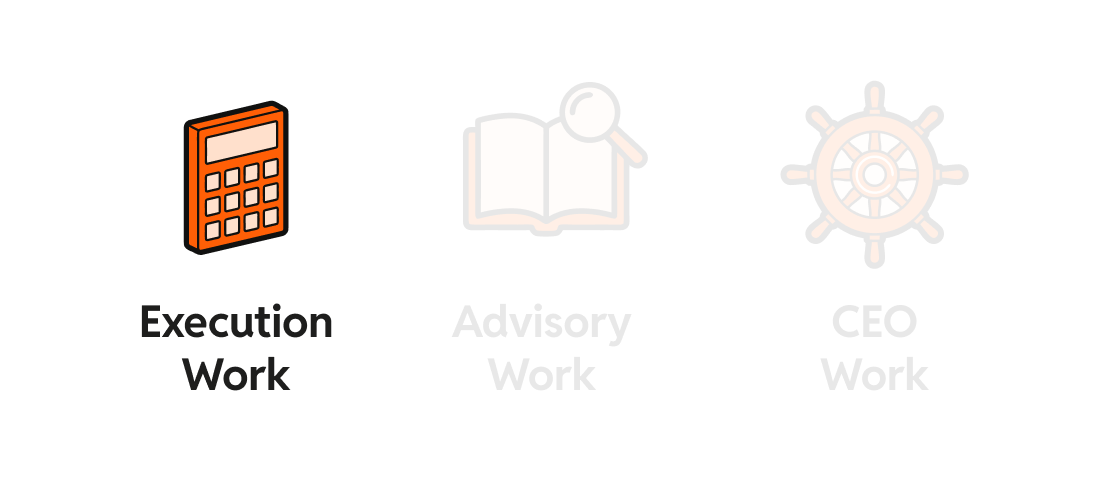
Role 1: Execution Work
Entering transactions. Categorizing expenses. Reconciling accounts. Generating reports. Filing documents. Processing payroll. Preparing tax returns.
This is the rinseable, repeatable work that keeps the business running. It’s important. It’s necessary. And it’s not the CEO’s job.
This is work for bookkeepers, virtual assistants, software, and custodian feeds. At the early stages, you might do some of it yourself to learn how it works. But the goal is always to move it off your plate as fast as you can — because every hour you spend on execution is an hour you’re not spending on the work only you can do.
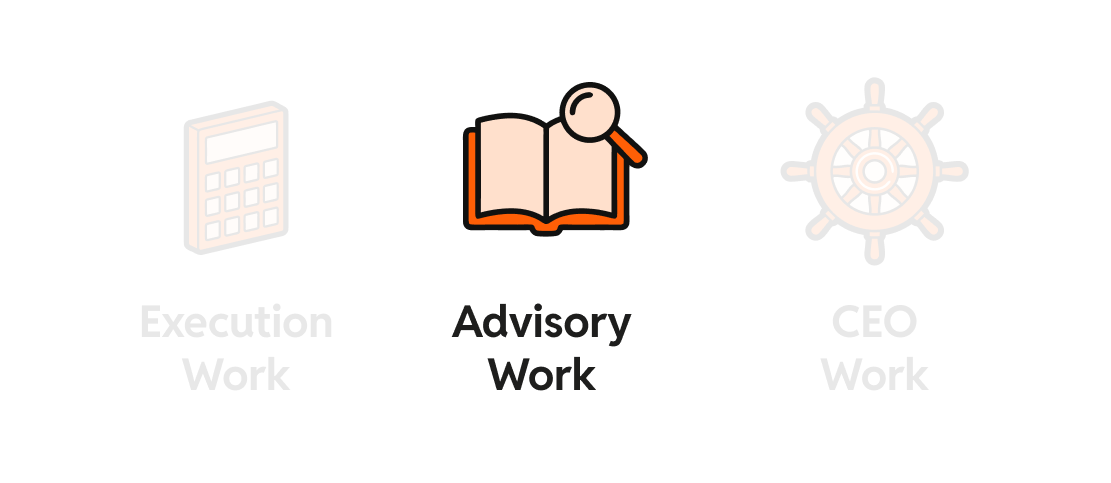
Role 2: Advisory Work
Tax strategy guidance. Legal counsel on entity structure. Estate planning recommendations. Investment due diligence support.
This is expert-level work where you hire specialists for their knowledge. Your CPA, your tax planner, your estate attorney, your investment advisor — these are people who bring expertise you don’t have.
But here’s the critical distinction: the advisor recommends. The CEO decides. The advisor brings their expertise to the table. You decide whether and how to apply it. You don’t abdicate the decision to the advisor — you use their input to make a better decision yourself.
That’s the exact mistake I made in that Morgan Stanley meeting years ago. I walked in asking them to be my CEO. Their model was happy to oblige. The better model is: I’m the CEO, you’re the specialist. Give me your recommendation. I’ll make the call.
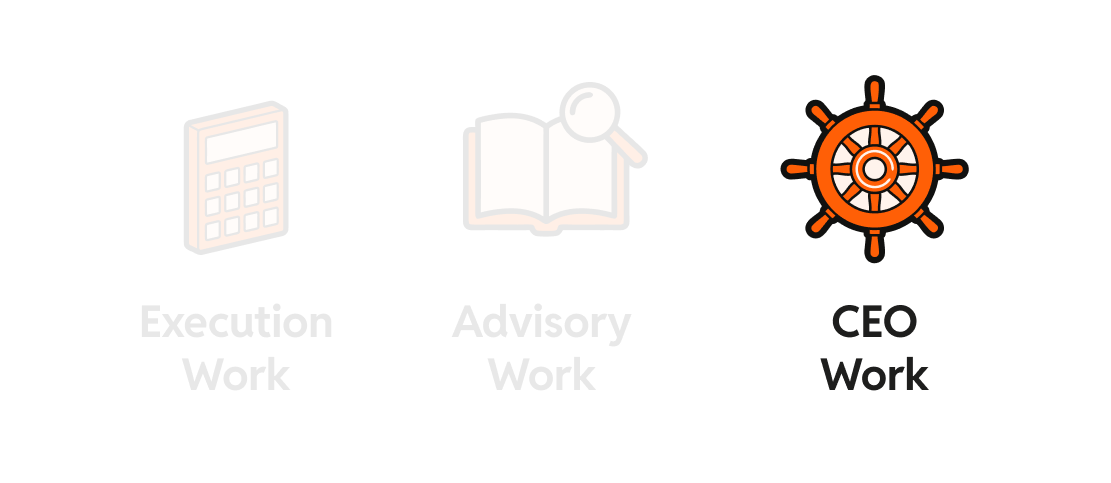
Role 3: CEO Work
Strategic decisions — which entities to form, which tax strategies to pursue, which advisors to hire, how to allocate the portfolio.
Foundational setup — organizing documents, defining what to track, mapping the tax calendar, setting success metrics.
Ongoing governance — quarterly reviews, maintaining the operational rhythm, family alignment, ensuring systems don’t degrade over time.
And one more that most people miss: financial literacy. Not just viewing the dashboard — understanding what the numbers mean. Reading the P&L. Knowing your cash position. Pattern recognition: is this trending up or down?
This is the work that cannot be delegated. Even with a full team — bookkeeper, CPA, tax planner, estate attorney — the CEO still owns strategy, governance, and the ability to read the numbers.
The Model: Understand, Oversight, Controls
Here’s what made this practical for me. For every process I handed off, I needed three things in place:
Understand: Not how to execute the work — but how it works well enough to know when something is wrong. I don’t need to know how to do a monthly close. I need to understand what a P&L shows me so I can tell if the numbers look right.
Oversight: What am I measuring? Where do I look? How often? What triggers a deeper review? Monthly I do a quick check — 10 minutes, P&L, cash position, dashboard. Quarterly I go deeper — trends, forecasts, review all seven components. Annually I audit everything.
Controls: Who has access to the money? I’m the signer on all bank accounts. I approve all transactions. I review all work before money moves. The bookkeeper doesn’t sign checks. That’s not distrust — it’s structure.
“You don’t abdicate when you delegate. You manage.”
This model ended my confusion. Before, delegation felt like giving up control. After, delegation felt like installing control. I knew exactly what I owned (strategy, governance, financial literacy), what I monitored (oversight cadence), and what protected the system (controls).
The Test
Here’s the question that tells you where you are:
In the last 30 days, how many hours did you spend on execution work vs. CEO work?
Execution: entering transactions, categorizing expenses, chasing documents, formatting spreadsheets, scheduling meetings.
CEO: reviewing the dashboard, making strategic decisions, evaluating advisor performance, aligning with your family on priorities, thinking about what to build next.
If execution is eating 80% of your time, you’re an employee of your own Family Office. The CEO is starving.
The fix isn’t to work harder. It’s to move the execution work to someone else — a bookkeeper, a VA, software, automation — and protect the CEO time for the work only you can do.
That’s what I did in 2017-2018. It’s the single operational decision that most changed how I run my Micro Family Office.
Key Takeaways
Three roles, one CEO. Every Family Office has execution work, advisory work, and CEO work. Only CEO work — strategy, governance, financial literacy — cannot be delegated. Everything else should be moving off your plate.
Delegate with structure, not faith. For every process you hand off, install Understand (know enough to spot problems), Oversight (define what to measure and how often), and Controls (who touches the money). That’s delegation without abdication.
Time audit reveals the truth. If execution is eating your hours, you’re not running a Family Office — you’re working in one. Protect the CEO seat.
Your Action This Week
Run a quick time audit on the last two weeks. Just a rough estimate:
How many hours did you spend on execution (data entry, filing, chasing documents, scheduling)?
How many hours did you spend on CEO work (reviewing performance, making strategic decisions, evaluating advisors, thinking about what’s next)?
Write both numbers down. The ratio tells you whether you’re the CEO — or the bookkeeper who happens to own the portfolio.
Let’s keep building.
—Christopher
P.S. When I finally hired a bookkeeper and moved the execution work off my plate, the first thing I noticed wasn’t the time savings. It was the clarity. I could actually think about the business instead of running the business. That shift changes everything.
Go Deeper
The problem this solves: I Had the Money. I Didn’t Have the Life. — why tracking growth alone doesn’t unlock anything, and the three disciplines that replace net worth.
Live workshop: The WealthOps Way — free, 2 hours. See how the CEO model works inside a real Family Office Dashboard.
This is education, not advice. Learn the systems, don’t copy blindly.

Join me for The Micro Family Office Blueprint—our free live workshop designed to help you stop guessing and start running your wealth like a business.
You’ll go from scattered to strategic as you craft your own Portfolio Thesis—the foundation of everything that follows.
Spots are limited—and the clarity you’ll gain? Game-changing.
Let’s build your portfolio like it’s your next great company!

If you like the newsletter, support us by letting us know what you think (one click); please do that now!
PS...If you're enjoying Managing Tech Millions, please consider referring this edition to a friend.
And whenever you are ready, there three ways I can help you:
Follow me on LinkedIn: Get more insights and real-time updates.
Watch on YouTube: Dive deeper into wealth strategies and interviews.
Get in Touch: Ready for a bigger move? Let’s talk.

Disclaimer: This newsletter is for informational purposes only and does not constitute financial or career advice. Always consult with qualified professionals before making any decisions based on the information provided.