


👋 Managing Tech Millions by WealthOps 📈 your go-to source for building wealth with tech equity and managing the money that comes with it.
Every week, we'll deliver a concise and powerful lesson on building wealth working for equity compensation or on managing your seven and eight-figure portfolio.


Today, in 5 minutes or less, you’ll learn:
📊 What I’m seeing in the 170 people who are already training to become Family Office CEOs
🎯 Why the ones moving are dramatically further than they expected — and why the ones stuck are stuck for the same 1–2 reasons every time
🗺️ The one move the movers all made (and what to do if you haven’t made it yet)

Hey Family Office CEOs,
Today is the midpoint of 2026.
Last week I made an on-the-record prediction that “Family Office CEO” will be a recognized professional role by 2030. The structural call. The bet I’m willing to defend in five years.
Here’s what I didn’t tell you:
Around 170 people are already training for it — and the number is growing every month. This year. Inside the Micro Family Office Accelerator. With me, and with the practitioners, educators, and experts we bring in alongside them.
Why I can see the pattern: I built this program from the practice. I’ve been running my own Micro Family Office for the last five years — and I built the Accelerator from the system that works. We took how Single Family Offices run at scale and scaled it down to our size. Lean. Practitioner-led. Built for $1M–$30M portfolios.
The role isn’t a forecast. It’s in active training. And six months in, the pattern is clear.

Managing Tech Millions is a Weekly Podcast that gives you deep dive conversations into building and growing wealth with myself and other industry experts.
This week, I’m breaking down covered call ETFs—and why that big yield number on the website isn’t what you actually keep.
Yield ≠ Income: A fund advertising 45% can quietly hand you back your own principal. Measure what you keep, not what they advertise.
Know What’s Under the Hood: OTM, ATM, 0DTE, synthetic—four strategies, wildly different outcomes. Same category, one returns 18%, another loses half your capital.
The Wrong Account Costs Thousands: Match a fund’s tax structure to the right account and the same $500K position can drop from ~$14,000 to ~$1,500 in federal tax.
Build the Foundation First: Core broad-market funds at the base, tactical single-theme funds at the top—if at all. Most people start at the top and skip the foundation.
One Tool, Not the Whole Plan: Covered call ETFs convert market exposure into cash flow. They don’t protect, grow, or last decades alone. They’re one component of a complete income architecture.

Pattern #1 — The Movers Are Further Than They Expected
The Accelerator members who started in January are dramatically further than they thought possible in six months.
Strategy defined. Foundation built. First entity formed. Expert Partner Team in place. Cadence running.
Six months of progress they expected to take eighteen.
Why this is happening: the program puts three legs of work into one place — and the combination is what compresses the timeline.
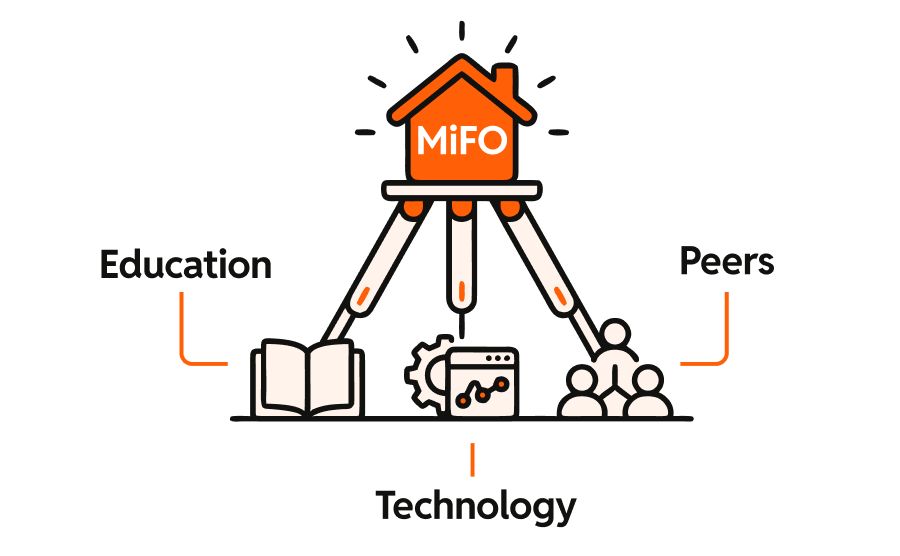
1. Education. Comprehensive end-to-end training on how to actually architect, build, and run a Family Office. Not gap-filling. Not assorted content. The whole build, in sequence, taught by people who do the work — me as the lead practitioner, plus the educators and experts we bring in to teach the deeper specialty layers. Practitioner-led, not theory-led.
2. Technology. Tools that let each person analyze where they are right now and see exactly what their next move is — personalized to their path, not generic advice. The diagnosis is specific. The next step is specific. The work stops being a research project and starts being a build.
3. Peers. Learning in community with other people doing the same work. Peers remove roadblocks. Peers accelerate decisions. Peers turn the loneliest work of wealth into the most connected hours of their week. The realization everyone has, usually around month three: we can go faster together than we can alone.
These three legs don’t exist together anywhere else. People try to assemble them — a book here, a podcast there, an advisor who maybe gets it, a community that doesn’t have the curriculum. The 170 stopped trying to assemble it themselves. They joined a program built on a single thesis: the lean version of what works at the Single Family Office level, scaled down to work for $1M–$30M portfolios — without the $1M–$2M-a-year overhead.
That’s the first move. Everything else follows from it.
Pattern #2 — The Stuck Are Stuck for the Same 1–2 Reasons
After 170 people, the stuck pattern is almost identical every time. It’s never the tactics. It’s always one or both of these:
Reason #1 — They’re trying to design the perfect plan before starting the imperfect one.
They want the full architecture before the first move. The whole entity structure mapped before they form the first one. The complete investment thesis before they make the first allocation. The perfect cadence before they hold the first meeting.
It doesn’t work. The architecture only reveals itself through doing. The people building have made peace with starting before they feel ready — and they’re discovering the structure as they build it.
Reason #2 — They’re trying to do this alone.
No peer practice. No accountability. No one to compare reality against. The 7th UHNW Principle is the leg most people skip — Build and Grow in Transparent Community — and it’s the leg that holds everything else up.
The unblock here is almost never tactical. It’s almost always structural — they don’t have the right environment around the work.
Notice what both reasons have in common: they’re both about the environment around the build, not the build itself. Pattern #1 is what the right environment looks like. Pattern #2 is what happens without it.
Pattern #3 — They Operate as a Business From Day One
The Accelerator members moving fastest aren’t chasing the fancy stuff first.
They’re not opening with exotic tax structures. They’re not racing to alternatives. They’re not optimizing entity gymnastics before they have a thesis.
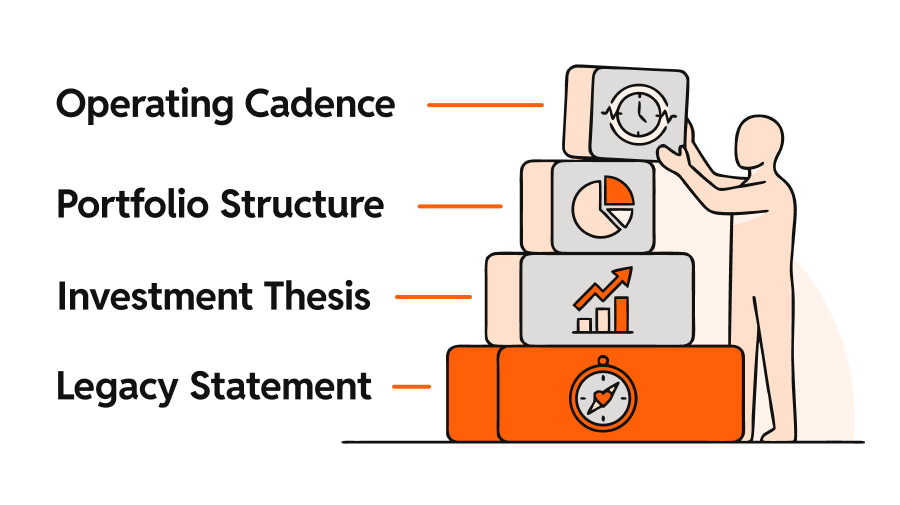
They’re building the foundation in this specific order:
Legacy Statement — what is this for
Investment Thesis — how we’re going to grow it
Portfolio Structure — where the capital actually goes
Operating Cadence — the rhythm that runs the family and the business
Only after that foundation is locked do they touch the more sophisticated layers — tax architecture, alternatives, entity refinement, succession structures.
Here’s why this works.
The people who respect this order are building something robust enough to compound on. They look slower at the start. They are dramatically faster eventually — because every subsequent layer is sitting on a foundation that can actually hold it.
The people who skip the foundation to chase a clever tax move or an alternative-investment opportunity end up with sophisticated structures sitting on no thesis, no cadence, no family alignment. The structures eventually fail because there’s nothing underneath them holding the weight.
They start operating as a business before they start optimizing as a portfolio. The ones who get that order right build something robust enough to compound on.
The Move the Movers Made
Three patterns. One synthesis.
The 170 people training inside the Accelerator made one decision the stuck people haven’t made yet:
They stopped trying to assemble this on their own.
They didn’t try to build the curriculum, find the right diagnostic, and stitch together a peer group themselves. They didn’t try to figure out the build sequence from scratch by reading every book. They committed to train as Family Office CEOs inside a program built for exactly that — and the work compressed.
The build doesn’t start with the first entity. It starts with the decision to stop trying to figure this out alone.
What To Do This Weekend If You’re Not Moving Yet
Three concrete moves. Frameworks, not advice:
1. Stop trying to design the perfect plan. Pick the one component (out of the 7) that’s most broken right now and start there. Not all of them. One.
2. Stop trying to do this alone. Find one peer — someone else building one of these. Not an advisor. Not a friend who’s curious. Someone in the actual work.
3. Get the foundation in the right order. Legacy Statement first. Investment thesis next. Portfolio structure after that. Operating cadence last. Don’t skip ahead. The order is the leverage.
Half the year is gone. The other half is yours to direct.
The 170 people training inside the Accelerator aren’t smarter than you. They’re just further into the move.
Let’s keep building.
—Christopher
P.S. If you read this and recognized yourself in Pattern #2 — the answer is to stop trying to assemble this on your own. The on-ramp is The WealthOps Way. Two free hours that show you what the build actually looks like before you commit to anything.
👉 Start here: The WealthOps Way — a free 2-hour live workshop where I walk through the foundation from the beginning. If you’re ready to actually train, the next step is the Micro Family Office Accelerator — where the 170 people referenced above are training.
Go Deeper
Last week’s issue: I Think a New Job Is About to Get Named — the structural prediction that Family Office CEO becomes a recognized professional role by 2030. This week shows the role is already in active training.
New here?
I’m Christopher. I built my Family Office after my 2012 IPO, spent over a decade studying how it actually works, and walked away from the workforce in 2022. Now I teach the framework at WealthOps. If this is your first issue — welcome. The best place to start is The WealthOps Way (wealthops.io/go). Free workshop, full framework, no pitch.
This is education, not advice. Learn the systems, don’t copy blindly.

Join me for The WealthOps Way—our free live workshop designed to help you stop guessing and start running your wealth like a business.
You’ll go from scattered to strategic as you craft your own Portfolio Thesis—the foundation of everything that follows.
Spots are limited—and the clarity you’ll gain? Game-changing.
Let’s build your portfolio like it’s your next great company!

If you like the newsletter, support us by letting us know what you think (one click); please do that now!
PS...If you're enjoying Managing Tech Millions, please consider referring this edition to a friend.
If this was useful, tap the ❤️ button. It tells Substack to show more writing like this.
And whenever you are ready, there three ways I can help you:
Follow me on LinkedIn: Get more insights and real-time updates.
Watch on YouTube: Dive deeper into wealth strategies and interviews.
Get in Touch: Ready for a bigger move? Let’s talk.

Disclaimer: This newsletter is for informational purposes only and does not constitute financial or career advice. Always consult with qualified professionals before making any decisions based on the information provided.