


👋 Managing Tech Millions by WealthOps 📈 your go-to source for building wealth with tech equity and managing the money that comes with it.
Every week, we'll deliver a concise and powerful lesson on building wealth working for equity compensation or on managing your seven and eight-figure portfolio.


Today, in 5 minutes or less, you’ll learn:
📊 Why the corporate title most executives are chasing feels different once they get there — and what that signal means
🎯 The transition I’m watching emerge: from money maker to money manager — and why it’s easier than most people think
🗺️ The three principles that separate executives who make this transition cleanly from the ones who get stuck

Hey Micro Family Office CEOs,
I’ll start with something I don’t usually lead with.
For a long stretch of my first career, my goal was to become a Chief Information Officer. CIO. The corner office, the seat at the executive table, the validation of having reached a level most people don’t reach.
I got there. And then something I didn’t expect: the title felt hollow.
Not because the work was unimportant. The teams I led, the systems we built, the problems we solved — that mattered. But it mattered for someone else’s company. For shareholders I’d never meet. For a strategy I executed but didn’t own. When I stepped back and looked at what I’d been building for two decades, I realized something that’s hard to admit out loud:
I’d been pouring my best work into someone else’s vision.
That wasn’t a complaint about my career. The first career did exactly what it was supposed to do — it taught me high-value skills and how to deliver value at scale. What I wanted now was to focus those same skills on my own mission and purpose. That’s what made it a turning point, not a grievance.

Managing Tech Millions is a Weekly Podcast that gives you deep dive conversations into building and growing wealth with myself and other industry experts.
This week, I’m tearing down the most expensive myth in wealth-building—that the fix for an advisor who’s outgrown you is simply a better advisor.
The unicorn hunt keeps you stuck: Chasing the one advisor who'll finally "get it" is exactly why high earners stay slotted into a cookie-cutter portfolio, paying 1% to be one of 100+ clients.
Welcome to the financial service desert: Between $1M and $30M, you're too complex for retail finance and too small for a traditional family office. The industry isn't built to serve you—so you build your own.
The structure the ultra-wealthy have used since 1882: Family offices manage over $10 trillion globally—more than every hedge fund combined—and they don't have portfolios. They run their wealth like a business.
The Micro Family Office, scaled to you: The same strategic advantages as a $100M Single Family Office, made cost-effective and implementable—running on four phases: Architect, Build, Run, Succession.
Stop being the client. Start being the CEO: This is the shift from money maker to money manager—and it’s the difference between a pile of money you spend down and a legacy that gets passed down.

What Family Office Work Has That Corporate Work Doesn’t
The role I’m in today — running my family’s wealth as a real family office, with the same operational rigor I used to bring to CIO work — has something the corporate title never had.
Real substance.
The people impacted by my decisions are my family. The capital I deploy — toward philanthropy, my kids’ education, businesses I believe in, communities I care about — actually ripples. The work I do this quarter still matters in a decade. It still matters in the next generation.
Most executive work doesn’t have that quality. You crush a project, ship a product, hit the number — and the cycle immediately resets. Next quarter. Next initiative. Next growth target. The wins are real, but they get absorbed into a treadmill that never stops moving.
Family office work is different. What you build inside your own institution doesn’t get absorbed. It compounds. The structure you put in place this year is still working ten years from now. The values you embed in how your family handles money show up in the next generation. The community you invest in becomes the actual inheritance — not the dollar number on a statement.
The Second Career I See Coming
Here’s the pattern I’m watching emerge — and I think it’s going to define the next decade for a generation of people who built real wealth.
Executives who spent their first careers building wealth — through tech equity, business ownership, professional practice — start to transition into a second career: owning and operating the business of managing that wealth. Not as a hobby. Not as a side project to whatever job pays the mortgage. As the actual business they get up to run every morning.
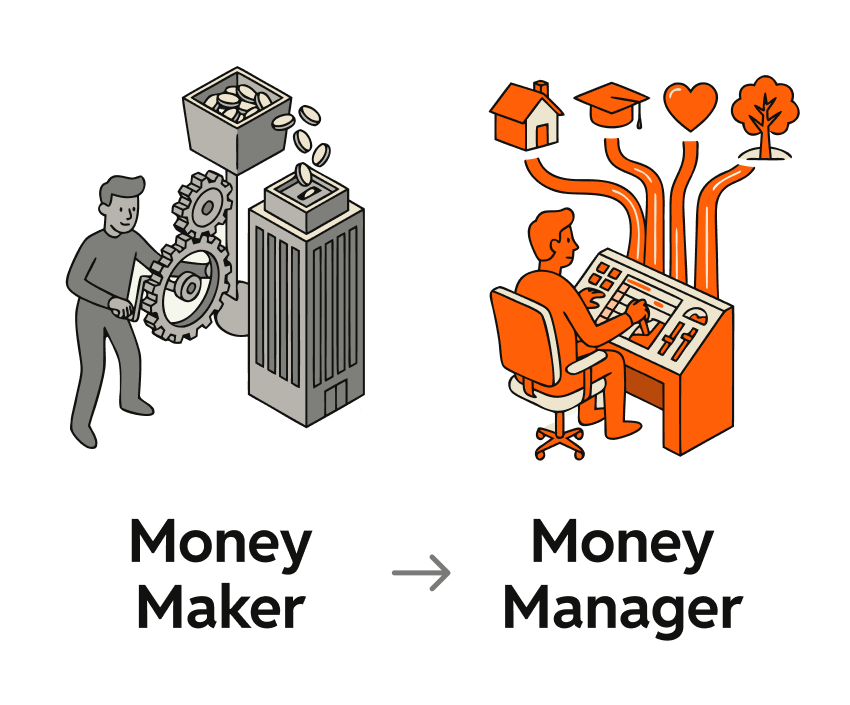
And here’s what most of them realize once they start: the transition is easier than they expected.
They already have the skills. They’ve built businesses, led teams, made capital decisions under pressure, hired specialists, set strategy, run a P&L. The work of managing wealth — at the family office level — is the same skill set applied to a different business. They’re not starting from zero. They’re translating.
Most executives over-index on what they don’t know yet (the tax mechanics, the entity structures, the alternative investment landscape) and under-index on what they already know (how to run a business). The former is learnable in months. The latter takes a career. Most of them already have the harder half.
Here’s the other part most people don’t see coming: it’s a rewarding business.
Not just financially. The wealth-management work, done right, unlocks a lifestyle for the family that the wealth-building career never could. Time. Presence. Geographic freedom. The ability to take a trip in March and not check the calendar. The ability to put kids through private school and invest in their next ten years and contribute to causes that matter — without trading any of it away.
People are going to wake up to a possibility most of them haven’t named yet:
You can have an extraordinary first career building something for someone else — then transition to a legacy business that builds something for your family, with impact that ripples for generations.
That second career is rare. That second career is meaningful in a way the first one structurally couldn’t be.
The Three Principles That Make the Transition Work
The transition doesn’t happen randomly. The executives who make it cleanly do it grounded in three principles:
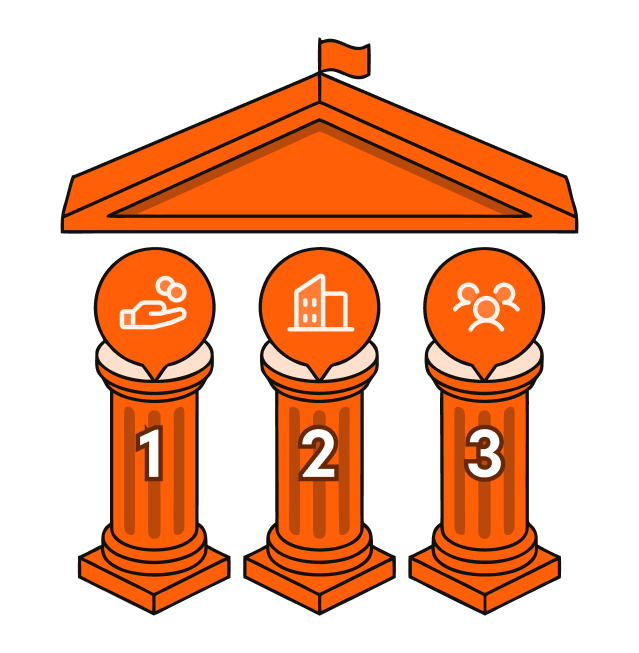
1. Stewardship — the conviction that wealth is entrusted, not owned. Managing it well is an act of service to people beyond yourself — your family, your community, the people who come after you.
2. Business building — the operational discipline of running this like a real enterprise. Systems. Governance. A CEO at the top. And the deliberate work of training the next generation — junior operators, future successors, your own family members — to run and scale it after you. A business built around one person is a job. A business built to outlast that person is a legacy.
3. Community — the recognition that this work can’t be done alone. People you walk alongside. Shared experiences that teach what books and frameworks never could. Peers who help you go forward — and who you help in return. It’s the truth most executives discover only after they leave their first career: we go further and faster together than we go alone.
Those three principles produce a different kind of operator. Not a hobbyist with QuickBooks. Not a high-earner who hands assets to an advisor and crosses their fingers. A CEO of a real institution built to outlast them.
What This Means for You
If you’re an executive, a business owner, or a professional who’s built real wealth — and you’ve been quietly noticing that the title you chased doesn’t feel the way you expected it to feel — pay attention to that signal.
It’s not a problem. It’s an invitation.
The first career did its job. The hollow feeling isn’t a sign that the work was wasted. It’s a sign that you’ve outgrown it — and that the second career, the one with real substance, is starting to come into view.
You’re more ready for it than you think. You already have the harder half of the skills. What you need now isn’t another corporate ladder to climb. It’s a different ladder, going somewhere that actually matters.
Your Action This Week
One honest question to sit with:
When I imagine the next twenty years of my career, am I climbing the same ladder I’ve been on — or am I quietly ready to start building something that ripples for the people I love?
If the answer is the second one, you’re already in the transition. You just haven’t named it yet.
Next Friday I’ll be back with the structural call: where the practice of wealth management is going for people making exactly this transition — with hard data and an on-the-record prediction about what role emerges as a result. This week is the personal half of that story. Next week is the structural half.
Let’s keep building.
—Christopher
P.S. The transition I just described — from money maker to money manager — is the entire mission of WealthOps. That’s what we do. We help experienced executives, business owners, and professionals make exactly that shift — grounded in stewardship, business building, and community — alongside others doing the same work.
If you read this and thought “that’s the transition I’m trying to figure out” — the answer is yes. And you don’t have to figure it out alone.
👉 Start here: The WealthOps Way — a free 2-hour live workshop where I walk through the foundation from the beginning.
Go Deeper
🎯 Start here if you’re new — The WealthOps Way Free, 2-hour live workshop. The foundation: what a Micro Family Office is, the two portfolio models, the 7 Components, and your own Legacy Statement.
Last week’s issue: I Think the Family Office Era Is Just Starting — the structural conditions making this transition possible: AI as operating layer, the $84T wealth wave, and the AUM model collapsing.
New here?
I’m Christopher. I built my Family Office after my 2012 IPO, spent over a decade studying how it actually works, and walked away from the workforce in 2022. Now I teach the framework at WealthOps. If this is your first issue — welcome. The best place to start is The WealthOps Way (wealthops.io/go). Free workshop, full framework, no pitch.
This is education, not advice. Learn the systems, don’t copy blindly.

Join me for The WealthOps Way—our free live workshop designed to help you stop guessing and start running your wealth like a business.
You’ll go from scattered to strategic as you craft your own Portfolio Thesis—the foundation of everything that follows.
Spots are limited—and the clarity you’ll gain? Game-changing.
Let’s build your portfolio like it’s your next great company!

If you like the newsletter, support us by letting us know what you think (one click); please do that now!
PS...If you're enjoying Managing Tech Millions, please consider referring this edition to a friend.
If this was useful, tap the ❤️ button. It tells Substack to show more writing like this.
And whenever you are ready, there three ways I can help you:
Follow me on LinkedIn: Get more insights and real-time updates.
Watch on YouTube: Dive deeper into wealth strategies and interviews.
Get in Touch: Ready for a bigger move? Let’s talk.

Disclaimer: This newsletter is for informational purposes only and does not constitute financial or career advice. Always consult with qualified professionals before making any decisions based on the information provided.