


👋 Managing Tech Millions by WealthOps 📈 your go-to source for building wealth with tech equity and managing the money that comes with it.
Every week, we'll deliver a concise and powerful lesson on building wealth working for equity compensation or on managing your seven and eight-figure portfolio.


Today, in 5 minutes or less, you’ll learn:
📊 The one question to answer before private equity ever goes in your portfolio
🎯 Where I’d start if I were doing it over, and where I wouldn’t
🗺️ What I look at now when I vet an operator

Hey Family Office CEOs,
Private equity is the one place in your portfolio where a mistake can’t be undone with a click.
Sell a stock you regret and you’re out by lunch. Back the wrong private fund and your money can sit there for five, seven, ten years while you wait. So the lessons here cost time, and time is the one thing you can’t buy back.
October is Private Equity Month in our community, and I’ve spent a lot of this month thinking about what I’d tell myself back in 2016, when I wrote my first checks into private funds. I got some things right. I got some things wrong. Here are the three lessons that stuck.

Managing Tech Millions is a Weekly Podcast that gives you deep dive conversations into building and growing wealth with myself and other industry experts.
This week, I’m breaking down whether a Micro Family Office actually makes sense at $5 million—and how to run the numbers honestly before you build one.
The Question Everyone Asks: At $5M, most people assume a family office is still out of reach, or that it’s overkill. Both assumptions skip the real question: what does running your wealth like a business actually cost, and what does it return?
What You’re Already Paying For: Most portfolios at this level already carry advisory fees, tax prep and scattered professional costs. Before you judge a MiFO’s cost, you need to see what your current setup really costs you every year.
Gross Cost vs. Net Cost: The sticker price of a Micro Family Office is only half the picture. The number that matters is what’s left after you account for the structure itself, and that’s where the math usually surprises people.
What You Get at $5M: The same 7 MiFO Components that run a $500M Single Family Office, sized down for your balance sheet. You run it with fractional specialists, not a full-time staff, and with operating discipline instead of overhead.
When It’s Not Worth It: This isn’t the right move for everyone. I walk through the situations where the structure doesn’t pay for itself yet, and what to focus on first if that’s you.
The Honest Answer: Whether a MiFO is worth it at $5M depends less on the dollar amount and more on whether you’re ready to run your wealth like a CEO, with a plan, a cadence and a system.

1. Know Why You Want It
“Everybody’s doing private equity” is the most common reason I hear, and it’s the worst one.
Private equity is a tool, and you have to know what job you’re hiring it for. One of the core principles of how the ultra-wealthy invest is Diversify Beyond Public Markets. The question is what you need the private side of your portfolio to do.
My why was very specific. After my IPO, I wrote some really big tax checks, and I was angry about it. I wanted income, around 8% cash-on-cash, that I didn’t have to hand most of back to the government. Private real estate fit that job, because a lot of the income comes back as depreciation and return of capital instead of ordinary income.
Knowing my why made a lot of decisions easy. It told me what kind of private equity to look at, and it told me what to walk past.
It also showed me my blind spot. I believed real estate was the most tax-efficient income vehicle out there, and for a while it was. But I over-rotated into it. Today the bulk of my income engine still comes from real estate, and most of that money is locked up. So I’m now moving more of my income into things I can sell tomorrow if I need to, like covered-call ETFs.
Revisit your why every year. It tells you what to buy, and it also tells you when you’ve bought too much.
2. Start With Something Simple Enough to Understand
When I started, I went slowly. I invested about $50,000 at a time, and it took me almost five years to deploy my first $500,000.
That pace felt painful then. I’m glad for it now, because every one of those checks taught me something, and I started with businesses I could understand.
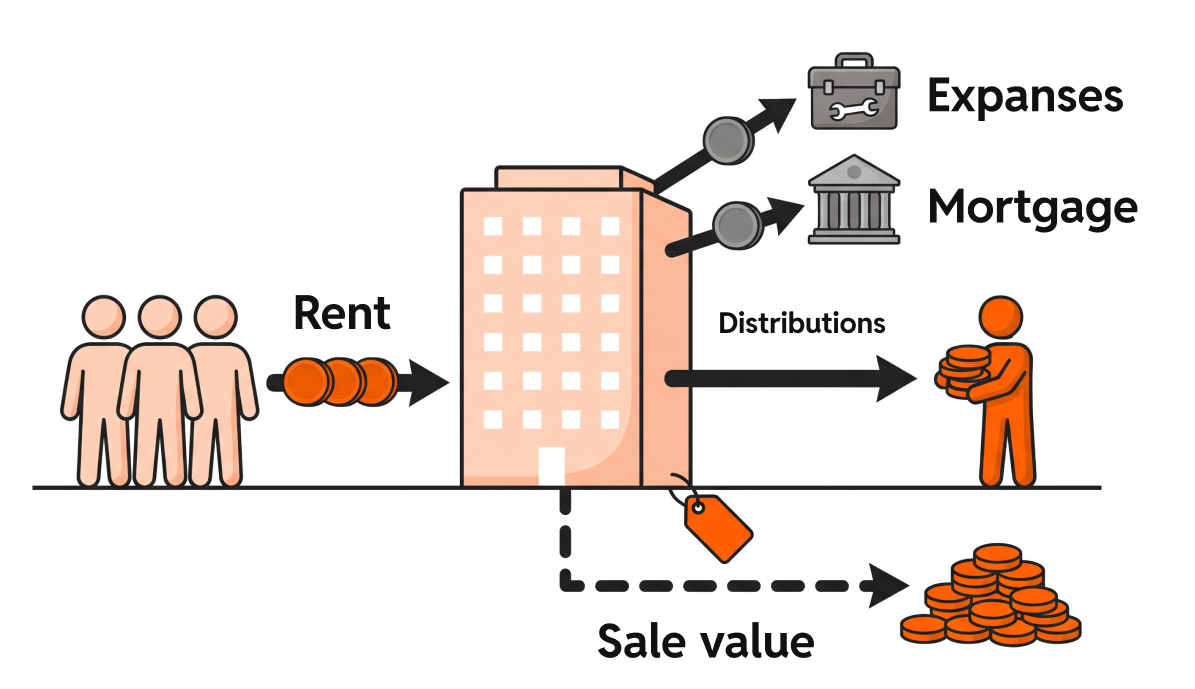
A private real estate fund that owns apartment buildings is a business you can learn. People pay rent. The operator pays expenses and the mortgage. What’s left gets distributed, and the building is worth something when it sells. A fund that owns industrial buildings works much the same way. You can get your arms around the fundamentals.
A leveraged buyout fund is a different animal. You’re betting on a firm that borrows heavily to buy operating companies, then tries to make those companies more valuable. There’s a lot to understand there, and you really do need to understand the underlying businesses before you’re in a position to judge it.
So my method was simple. Start small. Take a position. Learn how it actually behaves over a few years, including how and when it pays you and how it shows up on your taxes. Then go looking for lookalikes: other investments that work the same way, run by people who do it well.
Earn your way into complexity, one position at a time.
3. Vet the Operator as Hard as the Investment
This is the lesson I learned the hard way.
In 2016, 2017, and 2018, I invested with a couple of operators who were making money. The returns were good, and I felt smart.
What I didn’t understand yet was why they were making money. They were new to the business, and real estate had a lot of wind at its back in those years. Rising values made almost everyone look good.
As my education caught up, I went back and read their underwriting more carefully. I found they were writing in their own assumptions, using numbers that made the projections work rather than numbers pulled from real market data. So as each investment wrapped up and my capital came back, I didn’t reinvest with them. I no longer agreed with how they underwrote.
That changed how I vet everything. Anybody can build a financial model now. With AI, you can produce a polished one in an afternoon. So the model tells me very little. What I want to know is where the assumptions come from:
What rent growth are they assuming, and what data is it based on?
What exit price are they assuming, and what has that market actually sold for?
What interest rate are they assuming when the loan resets?
How did this operator do when the market wasn’t helping?
It’s the same rule I wrote about a few weeks ago with AI. The tools can screen and model all day long. The judgment about whether the assumptions are real is yours.
Key Takeaways
Know your why before you invest. Private equity should do a specific job in your portfolio. “Everyone’s doing it” isn’t a job.
Start with what you can understand. Real estate and industrial funds are learnable. Earn your way into complexity, a position at a time.
Vet where the operator’s assumptions come from. Anyone can build the spreadsheet. Ask where the numbers come from and how they performed without a tailwind.
Your Move This Week
Before you look at a single private equity opportunity this month, write one sentence:
“I want private equity in my portfolio because ___, and it has to do ___ for me.”
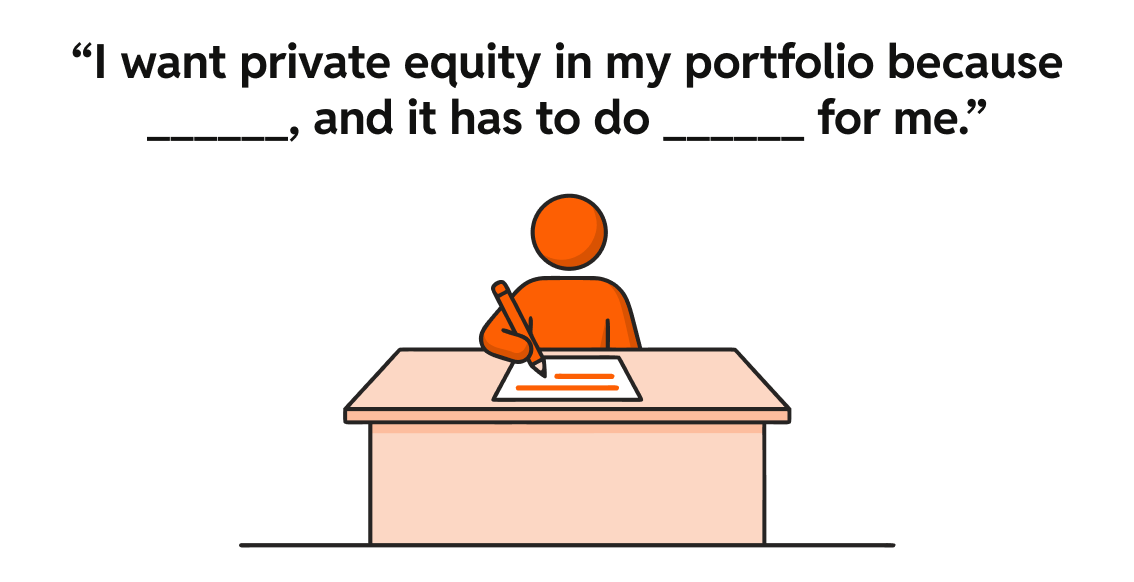
Fill in both blanks. Be specific: income, growth, tax efficiency, diversification away from your public stocks, or something else.
If you can’t finish the sentence, you’re not ready to invest yet. That’s useful to know too. Bring it to our Private Equity Month sessions, and we’ll work on it together.
Completion signal: the sentence is written.
Held beats pretty.
The operators I eventually walked away from were making money when I invested. What I couldn’t see yet was whether they’d keep making it once the tailwinds stopped.
Let’s keep building.
—Christopher
P.S. Private equity is one of the most-requested topics in our community, which is why October is Private Equity Month for our members: expert sessions plus working sessions, so members can understand the categories, the vetting, and the due diligence before they invest. That’s all inside the Micro Family Office Accelerator. If you’re not a member yet, start with The WealthOps Way.
👉 Start here: The WealthOps Way
Go Deeper
🎯 Start here if you’re new — The WealthOps Way Free, 2-hour live workshop.
The structured build path: Micro Family Office Accelerator — Year 1 of the WealthOps membership.
Recent arc:
One Year In: What 246 Families Actually Built — the member wins (confirm slug)
The Tax Checks That Made Me Angry — the Q4 tax system (confirm slug)
By 2030 AI Runs Your Wealth. Here’s the Trap. — AI as your operations manager, not your decision maker
Today: three lessons from years in private equity
New here?
I’m Christopher. I built my Family Office after my 2012 IPO, after googling “how to build a family office” and hitting the $100M wall the industry has quietly agreed on. Now I lead a community of more than 240 practitioners at WealthOps, and we’re building Eterna, the AI platform behind our approach. If this is your first issue, welcome. The best place to start is The WealthOps Way (wealthops.io/go). Free workshop, full rulebook, no pitch.
This is education, not investment advice. Private investments are generally limited to accredited investors, are illiquid, and can lose money. Do your own due diligence with your advisors.

Join me for The WealthOps Way—our free live workshop designed to help you stop guessing and start running your wealth like a business.
You’ll go from scattered to strategic as you craft your own Portfolio Thesis—the foundation of everything that follows.
Spots are limited—and the clarity you’ll gain? Game-changing.
Let’s build your portfolio like it’s your next great company!

If you like the newsletter, support us by letting us know what you think (one click); please do that now!
PS...If you're enjoying Managing Tech Millions, please consider referring this edition to a friend.
If this was useful, tap the ❤️ button. It tells Substack to show more writing like this.

And whenever you are ready, there three ways I can help you:
Follow me on LinkedIn: Get more insights and real-time updates.
Watch on YouTube: Dive deeper into wealth strategies and interviews.
Get in Touch: Ready for a bigger move? Let’s talk.

Disclaimer: This newsletter is for informational purposes only and does not constitute financial or career advice. Always consult with qualified professionals before making any decisions based on the information provided.