


👋 Managing Tech Millions by WealthOps 📈 your go-to source for building wealth with tech equity and managing the money that comes with it.
Every week, we'll deliver a concise and powerful lesson on building wealth working for equity compensation or on managing your seven and eight-figure portfolio.


Today, in 4 minutes or less, you’ll learn:
📊 The clinical name for what most first-generation wealth builders feel — and why nobody told you it has one
🎯 The 7th UHNW Principle most people misread — and what it actually means in practice
🗺️ The single practice that got me unstuck before I had architecture, operations, or strategy figured out

Hey Micro Family Office CEOs,
A few weeks after the IPO, I tried to talk to someone close to me — family — about what I was actually carrying. The fear. The weight of suddenly having to make decisions I wasn’t trained to make. The sense that one wrong move could cost generations.
Their response wasn’t supportive. The tone was something closer to: you’ve got this under control, right? You made the money — what’s the problem? Then the line itself:
“What are you crying about? You just won the lottery.”
I didn’t say much after that.
That single sentence did three things to me — and I didn’t have language for any of them at the time.
First, it revealed something I hadn’t fully realized myself: most people — including the ones closest to me — assume that making money and managing money are the same skill. They’re not. They’re completely separate disciplines. One is about earning. The other is about preserving, growing, and operating wealth as a long-term system. The first I’d spent a decade learning. The second I was about to spend the next twelve years learning. The person across from me had no idea those were two different things. And until that moment, neither did I.
Second, it discounted the work. An IPO isn’t a lottery ticket. It’s hard-won — years of building, hiring, executing, shipping under pressure, surviving things that nearly killed the company. Calling it a lottery quietly takes the shine off all of it. The comment said “you got lucky.” What I’d actually done was build. I didn’t have language for that layer at the time either, but I felt it.
Third, it told me how alone I was in this. Not because the person didn’t care. Because they had no lens for it — and most of the people in my life didn’t either. The people closest to you, more often than not, can’t see the weight of what you’re carrying. That’s not their fault. They’ve never been here. But the result is real: you carry this alone, or you find a way not to.
What I needed in that moment wasn’t a portfolio strategy. It wasn’t another book about wealth management. It wasn’t another spreadsheet. It was someone who could meet me in the conversation — someone who’d been here. Someone who understood that the dollar number on a statement is not the same as the weight you carry behind it.
I didn’t have that. And until I built it, nothing else in my Family Office really stuck.

Managing Tech Millions is a Weekly Podcast that gives you deep dive conversations into building and growing wealth with myself and other industry experts.
This week, I’m breaking down the SpaceX IPO that’s about to mint 160 new millionaires in Austin—and the 7 decisions every one of them needs to make before the windfall hits, not after.
Know Exactly What You Own: ISOs or RSUs? The tax treatment, vesting, and strategy all change. Skip this and every decision after it is built on a misunderstanding.
Build the Team Before the Event: Most people call a financial advisor first. The highest-leverage hires—an estate attorney and a Certified Tax Planner—belong in place before the stock prices.
Move Wealth While It’s Cheap: The hours before an IPO prices are the cheapest of your life to move stock into trusts. Once it’s liquid at peak valuation, those moves get expensive or impossible.
Use the Lockout to Plan, Not React: You can’t sell for 180 days, and the price will whipsaw. While everyone else checks the ticker 40 times a day, you build your divesting plan.
Decide Your Exposure on Purpose: Concentration builds wealth. Diversification preserves it. Letting it ride in a single stock isn’t investing—it’s hoping.
Communicate With Your Family Intentionally: When wealth lands, your family changes whether you tell them or not. Silence and the "wealth dump" both go sideways.

There’s a Name For What I Was Going Through
It took me years to learn that what I was experiencing has a clinical name: Sudden Wealth Syndrome.
Psychologists coined the term in the 1990s to describe what happens when someone crosses a major wealth threshold — IPO, inheritance, business sale, lottery — and finds themselves dealing with identity confusion, guilt, isolation, paralysis, and a low-grade anxiety that has nothing to do with the bank account number. It’s well-documented. It’s not weakness. It’s a predictable response to a fundamental change in your life that you weren’t trained for.
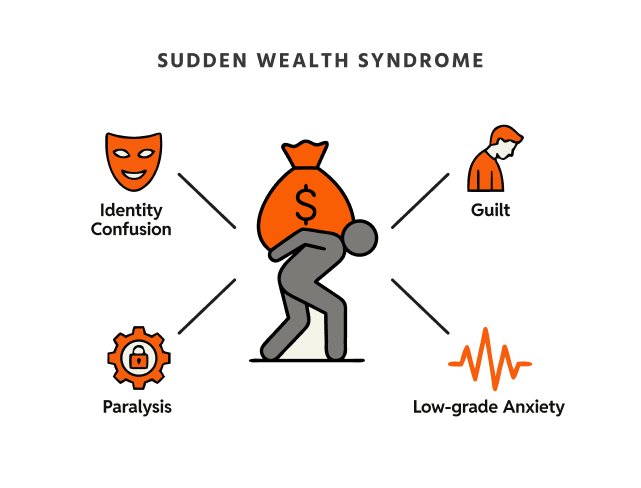
Most people I knew had never heard of it. The people closest to me certainly hadn’t. From the outside, my life had become easier in measurable ways. From the inside, the ground had shifted in a way nobody around me had vocabulary for.
And here’s the part that took me longer to see: you don’t have to have had a sudden wealth event to feel this. If you’ve spent twenty years building a $5M or $10M or $20M portfolio quietly, deliberately, methodically — the threshold still gets crossed. You still wake up one day realizing your decisions now affect generations. You still feel the weight. You still find that the people in your life don’t quite have the lens for what you’re navigating.
Sudden or slow, the pattern is the same. You need people who’ve been through it. People who can meet you in the experience. People who understand what it actually takes to get to where you are.
The 7th UHNW Principle
When I started studying how the ultra-wealthy actually operate — not the headlines, the operating model — I noticed something that surprised me.
There are seven principles that show up across every family office worth studying. Most of them are what you’d expect: generate income from assets, manage your wealth like a business, run it as a CEO. Those are the ones that get all the airtime.
But the 7th one is the one most people miss — and it’s the one that does more work than any of the others:
Build and Grow in Transparent Community.
Most people read that and think it means “make rich friends” or “join a peer group.” It doesn’t.
What it actually means: you can’t learn this alone. The conversations are what unlock the learning. If you want to figure out what the ultra-wealthy already know — what works, what fails, what nobody puts in books — you have to get uncomfortable and start talking about money. Out loud. With people who can meet you in the conversation.
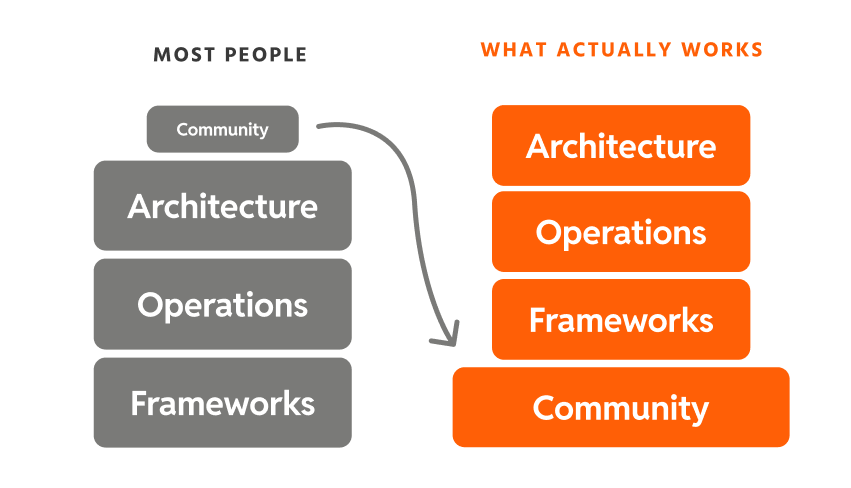
That’s the principle. And here’s the part that flipped how I thought about my own Family Office: community isn’t the leg you add at the end. It’s the leg you start with. Without it, you stay in your own head, you over-research, you under-act, and the emotional weight slowly grinds you down.
Why I Started the Podcast
I started Managing Tech Millions — the podcast that shares a name with this newsletter — because I needed something I didn’t have: a reason to keep having these conversations.
I didn’t start it because I had answers. I started it because I needed to force myself to get uncomfortable. To talk about money with people who’d built or were building real wealth. To ask the questions I wasn’t asking anywhere else. The podcast was a Trojan horse — its real job wasn’t to teach an audience. It was to teach me, by giving me a structured reason to be in the conversations I needed to be in.
And here’s what happened: the conversations did the work. Months of them. Then years. The frameworks that became WealthOps — the components, the architecture, the operations — those came out of the conversations. Not before them. The community came first. The content came out of the community.
That’s the inversion most people miss. They try to learn the frameworks alone, then assume community is a luxury you add later. The reality is the opposite: you can’t fully see the frameworks until you’ve been in real conversations with people on the same path.
Where You Go From Here
The action this week isn’t a worksheet. It’s an honest answer to one question:
Where in your life are you actually talking about money — not strategies, not portfolios, but the weight, the uncertainty, the questions you don’t ask anyone?
If the answer is nowhere — that’s the most important thing to fix this year. Not your asset allocation. Not your entity structure. The conversations you’re not having.
Find people on the same path. Build relationships with people who can meet you in the questions. Stop trying to figure this out alone. The 7th principle isn’t a luxury layer. It’s the one that holds everything else together.
Let’s keep building.
—Christopher
P.S. The reason The WealthOps Accelerator isn’t just a curriculum — and never will be — is because of exactly what I wrote above. The community inside the Accelerator is where members actually have these conversations: in calls, in cohort groups, in the kind of peer relationships that don’t naturally form for first-generation wealth builders. The frameworks are real and they matter. But the community is what makes the frameworks stick. If you’ve been building this alone and it’s been quietly grinding you down — that’s the part you may have been missing.
If you haven’t yet seen how the foundation fits together, The WealthOps Way is the on-ramp — a free 2-hour live workshop where I walk through the framework from the beginning.
👉 Start with the workshop: wealthops.io/go
Go Deeper
🎯 Start here if you’re new — The WealthOps Way Free, 2-hour live workshop. The foundation: what a Micro Family Office is, the two portfolio models, the 7 Components, and your own Legacy Statement.
The podcast: Managing Tech Millions — same name as this newsletter. Conversations with people building real wealth from the inside.
This is education, not advice. Learn the systems, don’t copy blindly.

Join me for The Micro Family Office Blueprint—our free live workshop designed to help you stop guessing and start running your wealth like a business.
You’ll go from scattered to strategic as you craft your own Portfolio Thesis—the foundation of everything that follows.
Spots are limited—and the clarity you’ll gain? Game-changing.
Let’s build your portfolio like it’s your next great company!

If you like the newsletter, support us by letting us know what you think (one click); please do that now!
PS...If you're enjoying Managing Tech Millions, please consider referring this edition to a friend.
If this was useful, tap the ❤️ button. It tells Substack to show more writing like this.
And whenever you are ready, there three ways I can help you:
Follow me on LinkedIn: Get more insights and real-time updates.
Watch on YouTube: Dive deeper into wealth strategies and interviews.
Get in Touch: Ready for a bigger move? Let’s talk.

Disclaimer: This newsletter is for informational purposes only and does not constitute financial or career advice. Always consult with qualified professionals before making any decisions based on the information provided.