


👋 Managing Tech Millions by WealthOps 📈 your go-to source for building wealth with tech equity and managing the money that comes with it.
Every Thursday, we'll deliver a concise and powerful lesson on building wealth working for equity compensation or on managing your seven and eight-figure portfolio.


Today, in 5 minutes or less, you’ll learn:
📊 Why net worth is the wrong top-level metric — and what family offices track instead
🎯 The three questions a real family office answers every month (and why most wealth-builders can only answer one)
🗺️ The single question that reveals whether what you’ve built is actually transferable — or just sitting in your head

Hey Portfolio CEOs,
I had a dashboard. Net worth was growing. The number kept climbing — grow, grow, grow. On paper, everything looked right.
But it wasn’t unlocking anything.
Regardless of how much it grew, nothing changed. I wasn’t getting more time with my family. I wasn’t able to take a sabbatical. I was still completely dependent on my job and my career. All this wealth — and it wasn’t providing me any additional freedom. I wanted to spend time with my kids. I wanted to slow down. And I couldn’t. I was just watching a number go up and wondering why my life felt exactly the same.
That’s when I realized: tracking net worth is the middle-class mindset. Growth is the obsession when you’re trying to get to your first million. But once you’re past that threshold, growth alone doesn’t get you where you actually want to go. You need to build capabilities — income, capital preservation — alongside the growth, or the number keeps climbing and nothing changes.

Managing Tech Millions is a Weekly Podcast that gives you deep dive conversations into building and growing wealth with myself and other industry experts.
This week, I’m breaking down how to architect a $25,000/month income portfolio—and why most well-funded portfolios generate almost nothing in recurring cash flow.
Growth ≠ Income: Appreciation doesn't pay your mortgage. Income requires a completely different set of vehicles, intentionally allocated.
The Three Buckets: Growth builds net worth. Capital Preservation gives you dry powder. Income pays you now. Most people skip the third.
The $7M Example: 50% income ($3.5M), 43% growth ($3M), 7% preservation ($500K)—structured for someone 2-3 years from retirement. Build the machine before you need it.
The Income Ladder: Foundation (30% / ~4.5% yield), Core (50% / ~9%), High-Yield (20% / ~13.5%). Blended ~8.5% on $3.5M gets you to $25K/month.
My First $530K (2013): A PE fund, two syndications, five rentals. 11% blended, $4,800/month. It worked—but I had no Tier 1 foundation and no investment thesis. That's the gap I want you to close.
The 3 Killers: Yield-chasing without understanding the source, skipping the foundation for high-yield plays, and ignoring tax treatment across the ladder.
Architecture is a decision. Make it intentionally.

The Three Questions Nobody Showed Me
When I started understanding how the ultra-wealthy look at their portfolios — through growth, income, and capital preservation instead of just total return — everything shifted. I wasn’t just tracking a number anymore. I was asking whether each part of my portfolio was doing its assigned job.
But that was only one question. A real family office answers three.
Not because three is a nice number. Because the business of wealth is bigger than investment performance. It has operations. It has a paper trail. It has an organizational logic that doesn’t live in one person’s head. If any of those three are broken, the whole thing is fragile — no matter how good the numbers look.
These three questions are how real family offices organize their dashboards. Let me walk you through them.
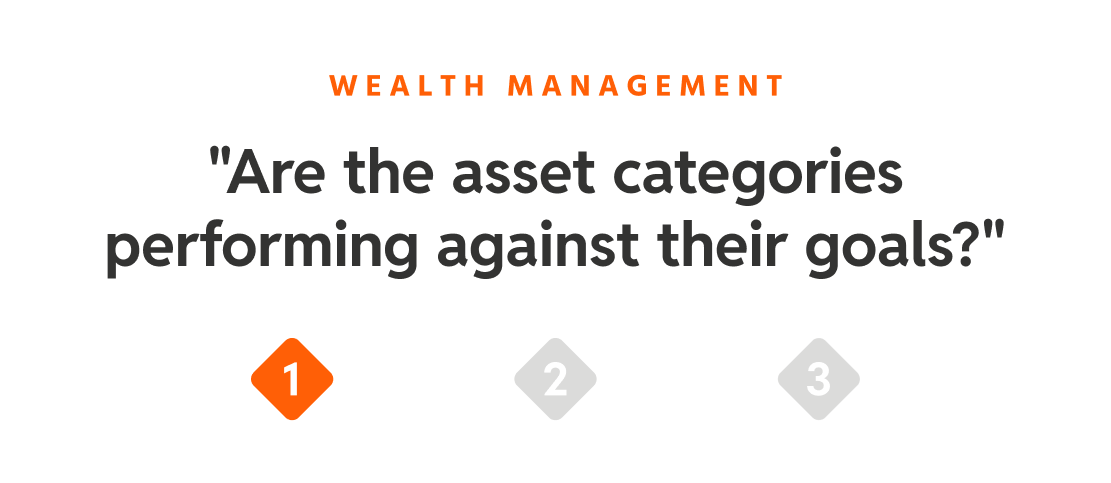
Question 1: Wealth Management
“Are the asset categories performing against their goals?”
This is the question most people think they’re already answering. They’re not.
“Is my portfolio up?” is not the same question. That’s a score. The real question is: for each asset category — growth, income, preservation — is it doing the job I assigned it?
Your income-generating assets aren’t supposed to grow aggressively. They’re supposed to produce cash flow. Your preservation layer isn’t supposed to produce high yields. It’s supposed to hold value during downturns. Your growth assets aren’t supposed to pay you. They’re supposed to compound.
Each has a job. The dashboard tells you whether each one is doing its job.
When you’re tracking net worth, a great year from your growth assets masks a terrible year from your income layer. The top-line number looks fine. But the architecture is actually broken. You won’t see it until the year your W-2 goes away and you realize your income layer was underperforming the whole time.
This is the first discipline. And most wealth-builders I talk to can’t actually answer it at the category level.
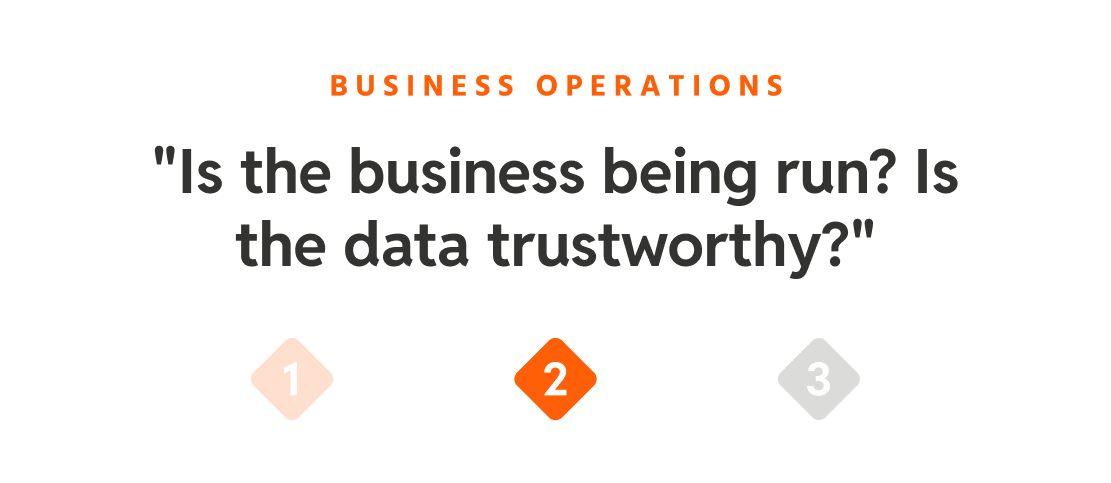
Question 2: Business Operations
“Is the business being run? Is the data trustworthy?”
This is the one most people skip entirely. And it’s the one that almost buried me.
By 2017-2018, the portfolio was growing and scaling, and everything was getting more complex. Entities, tax strategy, multiple accounts, multiple asset types. And I was doing all of it myself — the bookkeeping, the reconciliation, the record-keeping, the tracking. We were working so hard to operate this thing that it just became frustrating.
Then I had the aha moment: a CEO would never do the work of the bookkeeper. A CEO would hire one.
If I wanted to scale this — if I wanted to grow it beyond myself — I had to think about what roles I needed, what things I wasn’t good at as a CEO, and get out of those roles as fast as possible. We started hiring a bookkeeper. We started taking the basic, rinseable, repeatable stuff off my plate and bringing in people who could do that. So I could focus on the high-value work: managing the business.
A family office has a P&L. It has a monthly close. It has an audit trail. None of that happens when the CEO is also doing the data entry. And if none of it exists, what you’ve built isn’t a business — it’s a hobby with good returns. The minute you want to scale it, transition it, or hand any part of it to someone else, you discover you’ve been building on sand.
Is the business being run? If you’re still doing the bookkeeping yourself, you already know the answer.
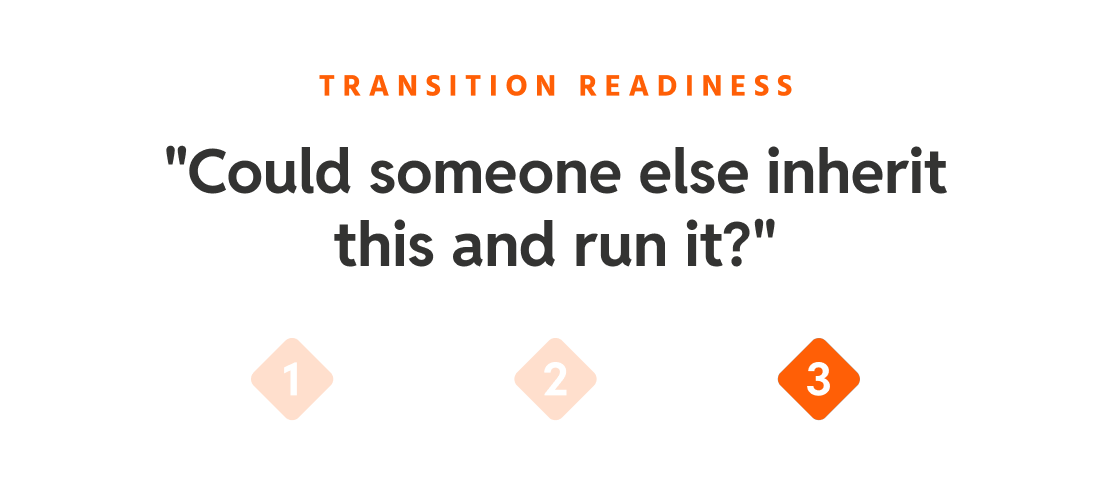
Question 3: Transition Readiness
“Could someone else inherit this and run it?”
This wasn’t triggered by a scare. It was triggered by being intentional.
When I started writing my legacy statement and really building this as a business, the thought followed naturally: you build any business and you think about succession. How do you actually hand this off?
My wife and I became diligent about starting with the fundamentals. Does she know where everything is? Do we have a strategy for what happens if something happens to me? What would her next moves be? Who would she call? Which decisions have already been made, and where are they documented?
We’ve seen friends where spouses passed away early. We’ve watched families scramble because the person who ran everything was the only person who knew how it all worked. That reinforced what we were already doing — but the practice didn’t start from fear. It started from the same principle that drives everything in the family office: intentionality.
Transition readiness isn’t something you think about when you’re old. It’s something you build into the operational rhythm from day one. Every document filed where someone else could find it. Every decision logged with the reasoning. Every advisor relationship documented. The business doesn’t need to be elegant. It needs to be legible to someone who isn’t you.
Here’s the test: if you disappeared tomorrow, how many weeks would it take the people who love you to figure out what you’d built and how to keep it running?
If the answer is more than a few weeks, you have a transition readiness gap. And that gap has nothing to do with your portfolio performance.
The Shift That Made All Three Work
Once I hired the bookkeeper and started delegating the operational work, something else shifted. I stopped spending my time in the weeds — and started spending it on interpretation.
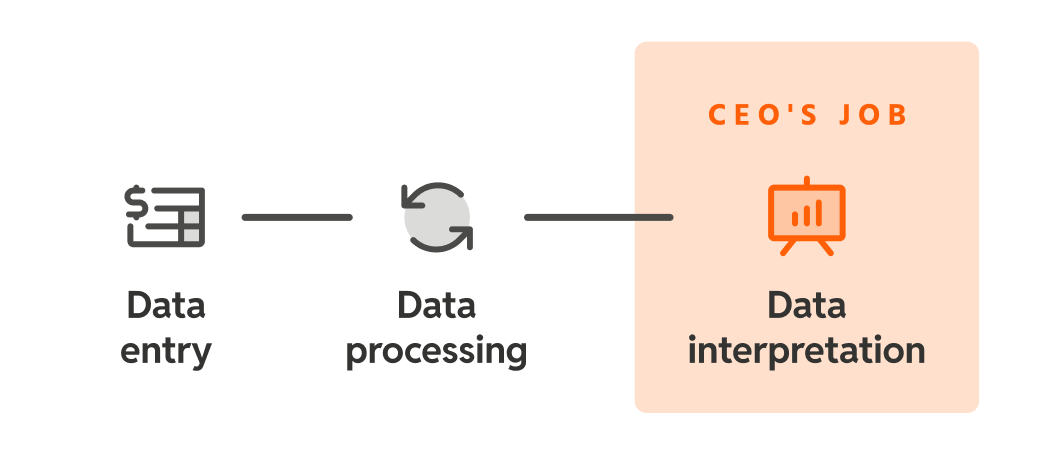
There are really three roles in any data system, and only one of them is CEO work:
Data entry — transactions, balances, categorization. Automate or delegate.
Data processing — reconciliation, reports, totals. Automate or delegate.
Data interpretation — reviewing the dashboard, identifying trends, making decisions. This is the CEO’s job. This cannot be delegated.
Your scarcest resource isn’t money. It’s the wisdom you’ve built through experience. When you’re buried in data entry, that wisdom stays trapped in your head. When you’re reading the dashboard and making decisions, that wisdom becomes visible — and eventually, teachable to whoever comes next.
That’s the shift. Stop doing the bookkeeper’s job. Start doing the CEO’s job. The three disciplines only work when there’s a CEO in the seat reading them.
Key Takeaways
Net worth isn’t the metric. A family office tracks three disciplines: Wealth Management (are asset categories performing their jobs?), Business Operations (is the business running?), and Transition Readiness (could someone else inherit and operate this?).
Most wealth-builders can only answer Discipline 1 — and not even that one correctly. They’re tracking their portfolio. They’re not running a business. And they have nothing documented that would let anyone else step in.
Your job is interpretation, not data entry. The CEO reads the dashboard and decides. Everything else — entry, processing, reporting — is delegated or automated. Confusing those roles is how CEOs burn out on their own wealth.
Your Action This Week
Pick one of the three disciplines and ask yourself honestly: what would it reveal if I had to show this to someone right now?
Wealth Management: Could I pull up a single view of how each asset category is performing against its goal?
Business Operations: When were my books last reconciled? Where’s my consolidated P&L? Who reviewed it?
Transition Readiness: If I disappeared tomorrow, how many weeks would it take my family to figure out what I’ve built and how to keep running it?
Whichever one gave you the most uncomfortable answer — that’s the discipline that needs attention first.
Let’s keep building.
—Christopher
P.S. You already know this from the last few weeks: the architecture matters, the three behaviors matter, income capability matters. This is the framework that tells you if any of it is actually working. Architecture without measurement is just hope dressed up in a spreadsheet.
Go Deeper
The architecture behind it: I Discovered How the Ultra-Wealthy Actually Build Portfolios — the three behaviors (income, preservation, growth) that Discipline 1 measures.
Live workshop: The WealthOps Way — free, 2 hours. See how the Three Disciplines come together in a working family office dashboard.
This is education, not advice. Learn the systems, don’t copy blindly.

Join me for The Micro Family Office Blueprint—our free live workshop designed to help you stop guessing and start running your wealth like a business.
You’ll go from scattered to strategic as you craft your own Portfolio Thesis—the foundation of everything that follows.
Spots are limited—and the clarity you’ll gain? Game-changing.
Let’s build your portfolio like it’s your next great company!

If you like the newsletter, support us by letting us know what you think (one click); please do that now!
PS...If you're enjoying Managing Tech Millions, please consider referring this edition to a friend.
And whenever you are ready, there three ways I can help you:
Follow me on LinkedIn: Get more insights and real-time updates.
Watch on YouTube: Dive deeper into wealth strategies and interviews.
Get in Touch: Ready for a bigger move? Let’s talk.

Disclaimer: This newsletter is for informational purposes only and does not constitute financial or career advice. Always consult with qualified professionals before making any decisions based on the information provided.