


👋 Managing Tech Millions by WealthOps 📈 your go-to source for building wealth with tech equity and managing the money that comes with it.
Every week, we'll deliver a concise and powerful lesson on building wealth working for equity compensation or on managing your seven and eight-figure portfolio.


Today, in 5 minutes or less, you’ll learn:
📊 The three structural conditions that are about to compress the family office model down-market
🎯 Why “tech-enabled DIY” is the wrong way to think about what’s coming (and what the right frame is)
🗺️ What this means for you specifically — whether you’re at $1M trying to figure out where to start, or $20M wondering if you’re behind

Hey Micro Family Office CEOs,
Here’s a call I’m willing to put my name on for the next decade — and defend in 2035 either way:
More people are going to own and operate their own Micro Family Offices in the next ten years than at any point in the history of wealth management. Not because everyone will become a billionaire. Because technology and structured frameworks are about to make it possible for someone at $2M, $5M, $15M to run the same disciplined, systematic operation that used to require a $500K-a-year team. The Family Office stops being something only the ultra-wealthy have. It becomes something a first-generation wealth builder builds — with intent and agency.
That’s the call. The rest of this newsletter is the case.

Managing Tech Millions is a Weekly Podcast that gives you deep dive conversations into building and growing wealth with myself and other industry experts.
This week, I’m talking about who’s actually sitting in the CEO chair of your wealth—and why it’s probably not you.

The Three Conditions Already in Motion
This isn’t a vibes prediction. Three things are happening simultaneously, and each one independently strengthens the case. Together, they’re decisive.
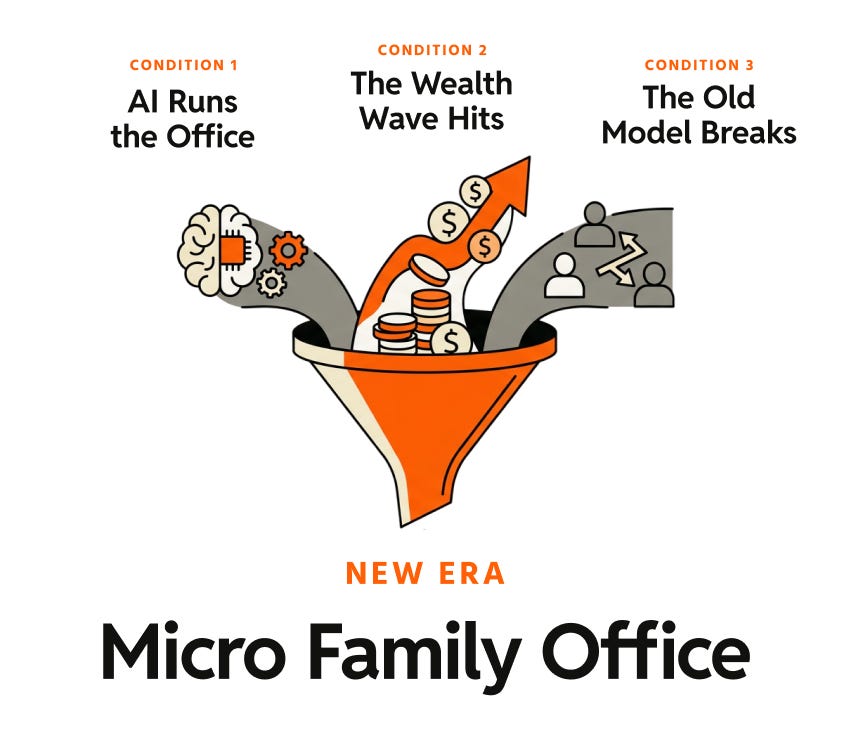
Condition 1: AI is doing the work that used to require a family-office staff — across the entire operating stack.
It’s not just the administrative side. AI is now doing:
Administrative throughput — multi-entity bookkeeping, document workflows, cash-flow tracking, performance dashboards
Financial analysis — P&L modeling, tax-strategy scenarios, “what-if” planning, consolidated reporting across entities
Portfolio analysis — allocation drift tracking, performance attribution, rebalancing scenarios, risk modeling, comparing fund options on an after-tax basis
The work that used to take a 4-7 person family-office team — at $500K-a-year — is being absorbed by AI-orchestrated systems that a single wealth-holder can operate. A $20K-a-year worth of bookkeeper + CPA + the right AI-assisted tools, organized by an informed CEO who knows what to ask for, now produces what a full staff used to produce. That single shift — AI as the operating layer, not just an investment theme — is what permanently changed the economics of family-office discipline. The math doesn’t just allow this. It demands it.
Condition 2: The first-generation wealth wave is the largest in history.
Tech equity, business sales, the Boomer wealth transfer — all stacking in the same decade. Cerulli alone puts the Boomer transfer at $84 trillion-plus moving to heirs and charity by 2045. That’s one engine. There are others.
There’s an entire generation of people in the $1M-$30M tier who’d never qualify for a traditional Single Family Office (those start at $100M+) but who have wealth that absolutely deserves family-office discipline. Without a structure designed for them, they were stuck choosing between “do nothing” and “hire an advisor who’s misaligned with what you actually need.” That’s about to change.
Condition 3: The traditional advisor model is structurally misaligned with what this tier needs.
AUM compensation can’t recommend strategies that move assets off-platform (alternatives, real estate, entity structures, business-side income generation). At smaller portfolios that misalignment is tolerable. At $5M+ where the right strategy almost always involves off-platform structures, the model breaks. The wealth-builders are already feeling this. They’re already looking for something else. They just don’t have a category name for it yet.
The category name is Micro Family Office. And it’s about to grow.
The Part Nobody Else Is Saying
Every major family-office report — UBS, J.P. Morgan, Citi — talks about AI as something family offices invest in. An asset-allocation theme. A portfolio question. “How are family offices deploying capital into AI?”
Nobody is talking about AI as the operating layer that just made Micro Family Offices viable at scale.
There are two completely different AI conversations happening, and they keep getting collapsed into one:
Investment AI — AI as something you BUY (a holding, an ETF, an exposure). The institutional reports are obsessed with this one.
Operating AI — AI as the layer that DOES THE WORK of running a family office. Administrative throughput, financial analysis, portfolio analysis, scenario modeling. The work that used to require a staff. The conversation that almost no one in wealth management is having.
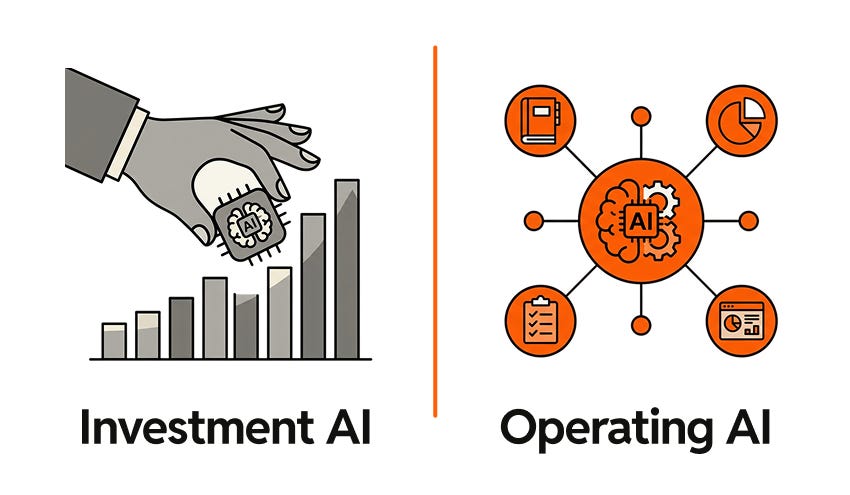
Investment AI changes how family offices deploy capital. Operating AI changes who can run a family office in the first place. That’s the distinction. That’s the unlock.
I’m betting heavily on the second one. The first one is a sideshow for the practitioner.
The first wave of family-office AI conversation is about portfolios. The second wave — the one that actually matters for the wealth-holder — is about operations. And we’re already inside it.
“Tech-Enabled DIY” Is the Wrong Frame
The instinctive way to read this prediction is “Christopher thinks people will start managing their own money with software.”
That’s not what I’m saying. That framing completely misses what’s actually shifting.
Here’s the right frame:
This isn’t DIY. You’re building and scaling a business — using AI to do it.
That’s what a family office is. Not a hobbyist with QuickBooks. Not a high-earner who hands assets to an advisor and crosses their fingers. A real family office — at any scale — is an institution:
CEO-led with a clear mission, purpose, and remit
Intentionally architected — entities, allocations, income lines, governance
Professionally supported — bookkeeper, CPA, tax planner, attorney, sometimes a fractional CFO
With its own embedded intelligence and process — increasingly powered by AI doing the analytical and administrative throughput
Designed to outlast the founder — so successors (spouse, next-gen, professional managers) can step in, operate it, and scale it when the founder is gone
That’s what makes it a family office and not a Robinhood account with a CPA on the side. It’s an institution built to outlive the person who started it.
The reason this is the decade it becomes accessible at the $1M-$30M tier is because AI just gave the wealth-holder the embedded intelligence layer that used to require a $500K-a-year staff. The institution-building isn’t different. The cost of building one just collapsed.
This is what the ultra-wealthy have always understood. They build institutions, not portfolios. The prediction is that the same institution-building is now within reach for everyone running real wealth — not just the families with nine zeros after their name.
What This Means For You Specifically
If you’re at $1M-$5M and just figuring out where to start: you’re early, and that’s the right place to be. The structures, the cadence, the team — none of it is exotic. It’s learnable. The cost of being early is a few years of effort. The cost of being late is a decade of compounding lost.
If you’re at $5M-$15M and you’ve been outsourcing the thinking to an AUM advisor: the misalignment is going to get more visible every year. Either you take the CEO seat or someone else is sitting in it — and they’re not optimizing for what you actually want. The shift here isn’t “fire your advisor.” It’s take the CEO seat and reposition every professional on your team as a specialist who reports to you.
If you’re at $15M-$30M and operating without family office structure: you’re already running one — it’s just informal and undocumented. Making it formal isn’t more work. It’s the move that turns informal effort into transferable system. The difference becomes obvious the day you can’t be the one operating it.
In every case, the underlying skill is the same: intent + agency. Knowing what you’re building. Owning the decisions. Surrounding yourself with the team and tools that let you operate at the scale your wealth has reached.
The Counter-Arguments (And Why I Still Make This Call)
“Most people won’t bother. They’ll outsource.”
Some will. The ones who don’t are going to dramatically out-perform — not because they’re smarter, but because their decisions are aligned with their goals. As the gap becomes visible, more people cross over.
“Tech can’t replace expertise.”
Correct. The prediction isn’t that tech replaces expertise. It’s that tech does the administrative work so practitioners can focus on the expertise-level work that only humans can do. Different role for tech. Different leverage point.
“This is what wealth managers already do.”
Not really. Wealth managers manage portfolios. A Micro Family Office is a business run by a CEO, with portfolios as one component. Different scope. Different operating model.
What I’m Doing Next
This is the first in a monthly series of on-the-record predictions about where the practice of wealth management is going. Same rules every time: must be about the practice (not markets), must be falsifiable, must be defensible in 3 years.
If you want to track these — or join the practitioners I’m building this with — the next prediction drops in July. Next Friday I’ll have a mid-2026 reset on where I’m pointing the back half of the year.
Let’s keep building.
—Christopher
P.S. If this prediction lands and you’ve been thinking “that’s what I’m trying to do, I just don’t have the playbook” — that’s exactly who WealthOps is built for. The infrastructure for the prediction coming true is what we’re working on every day.
Go Deeper
🎯 Start here if you’re new — The WealthOps Way Free, 2-hour live workshop. The foundation: what a Micro Family Office is, the two portfolio models, the 7 Components, and your own Legacy Statement.
Last week’s issue: I Didn’t Win the Lottery — the Lottery Comment story and why the 7th UHNW Principle (Build and Grow in Transparent Community) is the leg most people skip.
This is education, not advice. Learn the systems, don’t copy blindly.

Join me for The WealthOps Way—our free live workshop designed to help you stop guessing and start running your wealth like a business.
You’ll go from scattered to strategic as you craft your own Portfolio Thesis—the foundation of everything that follows.
Spots are limited—and the clarity you’ll gain? Game-changing.
Let’s build your portfolio like it’s your next great company!

If you like the newsletter, support us by letting us know what you think (one click); please do that now!
PS...If you're enjoying Managing Tech Millions, please consider referring this edition to a friend.
If this was useful, tap the ❤️ button. It tells Substack to show more writing like this.

And whenever you are ready, there three ways I can help you:
Follow me on LinkedIn: Get more insights and real-time updates.
Watch on YouTube: Dive deeper into wealth strategies and interviews.
Get in Touch: Ready for a bigger move? Let’s talk.

Disclaimer: This newsletter is for informational purposes only and does not constitute financial or career advice. Always consult with qualified professionals before making any decisions based on the information provided.