


👋 Managing Tech Millions by WealthOps 📈 your go-to source for building wealth with tech equity and managing the money that comes with it.
Every week, we'll deliver a concise and powerful lesson on building wealth working for equity compensation or on managing your seven and eight-figure portfolio.


Today, in 5 minutes or less, you’ll learn:
📊 The one sentence I scratched out in 2016 that turned my portfolio from a hobby into a business
🌱 Four moves that turn a Legacy Statement from words on a page into the operating anchor of your family’s wealth
🗺️ The one question to sit with this weekend before you write yours

Hey Family Office CEOs,
Last week I told you the one habit every Family Office CEO holds — a real Family Office meeting, with your family, held on a rhythm. Not the CEO’s solo operational work. The actual conversation with the people you’re building this for.
A few of you wrote back with the same question:
“OK. But what do we actually talk about?”
That’s this week.
The answer is the Legacy Statement. Not a wall document. Not aspirational poetry. Not a mission statement someone hands you at an onboarding retreat. The single operational sentence that gives your family’s wealth a purpose — and gives every conversation about that wealth a spine.
I know this one because I wrote mine ten years ago, out of frustration, in the middle of what looked like a winning career.

Managing Tech Millions is a Weekly Podcast that gives you deep dive conversations into building and growing wealth with myself and other industry experts.
This week, I’m breaking down how the 1% actually run their wealth—and why it has nothing to do with a better advisor or a better stock pick. It’s structure.
The 99% vs. the 1%: Most people hand their money to an advisor and hope it lasts. The wealthy run their wealth like a business built to outlast them.
The Financial Service Desert: You’re too complex for retail banks and too small for traditional family offices—so nobody hands you the playbook. That ends here.
Four Phases, Seven Components: Every family office—$500M or your scaled-down version—runs on the same architecture: Architect, Build, Run, Succession.
You’re the CEO, not the client: A Micro Family Office swaps full-time staff for fractional experts who execute your strategy. You set the vision and make the calls.
The real payoff isn’t the number: Building mine bought back my time—so I spend it with my family instead of trading hours for a paycheck. That’s what running wealth like a business actually buys you.

The Most Important Thing You’ll Build
Here’s what I’ve come to believe after ten years running my own Family Office and coaching close to 200 wealth builders through theirs:
The Legacy Statement is the single most important part of building a Family Office.
Not one of the most important. The most.
Every other component — the entity structure, the investment thesis, the operating cadence, the Expert Partner Team, the tax architecture — sits downstream of it. Without a Legacy Statement, those pieces are just tactics. Sophisticated tactics, maybe. But tactics.
With a Legacy Statement, they become a business — every entity, every investment, every quarterly meeting aimed at the same mission the family aligned to. Everyone on the team — family, advisors, next-gen — building toward the same thing.
That’s why every real Family Office starts here. And why families that skip it end up with expensive infrastructure that no one can explain the purpose of.
Let me tell you where mine came from.
2016. On Paper, I Was Winning.
I was a Chief Information Officer. Highest rung I could climb inside the org. Corner office. Board access. Speaking engagements. The kind of role I’d been aiming at for two decades — and I’d landed it.
And I was miserable.
Not dramatically. Quietly. I was spending Friday nights in a glass office while my kids grew up without me. I was chasing IPO after IPO — three of them, back to back — and the wealth was accumulating, but I couldn’t tell you what the wealth was for. I had built a portfolio the way I’d built my career: chase growth, take the meeting, hit the number.
I was, in the honest words I’d only later have for it, a portfolio CEO without a purpose. Investing without direction. Making money without meaning.
One night in 2016, after another late one, I sat down and scratched out one sentence in a notebook:
“I want financial independence to spend more time with my family.”
Eleven words. Two minutes. Done.
I didn’t know it at the time, but that was my first Legacy Statement.
What That One Sentence Did
Instantly, the fog lifted.
Not because the sentence was profound. It wasn’t. It was the most obvious thing I could have written. The unlock was that I’d written it down.

But here’s the part most people miss about what a Legacy Statement actually does.
It didn’t just give me direction. It gave me hard requirements.
“Spend more time with family” wasn’t just a vibe. It translated into a specific business requirement: to walk away from the corporate paycheck, I calculated I needed $175,000 in annual portfolio income. That was the number the sentence produced. Not a nice-to-have. A hard requirement.
And once I had the number, my entire portfolio architecture had to change:
I needed income-generating assets — because you can’t spend more time with your family if your paycheck is still what keeps the lights on
I needed to derisk aggressively — 97% of my wealth was in a single stock. If that company missed earnings, I could lose my job and half my net worth in the same afternoon. The sentence made that risk unacceptable.
I needed capital preservation — a buffer big enough that I could walk away without stress
Suddenly my portfolio wasn’t a hobby anymore. It had a job — and a specific list of requirements to meet that job. Every decision got simpler because I had a real filter: does this move me toward the sentence? If not, I passed.
That’s what most people miss about a Legacy Statement. It’s the directional document — the why. AND it’s the source of the hard requirements that tell you exactly what to build. Direction and implementation, from the same sentence.
That’s what turned money-making into money-managing aimed at something specific.
Why This Isn’t a Fluffy Exercise
Two families you might have heard of.
The Vanderbilts. In the late 1800s, Cornelius Vanderbilt was the richest man in America — worth over $100 billion in today’s dollars. By 1973, the family held a reunion. 120 Vanderbilt descendants showed up. Not a single one was an inherited millionaire. The fortune had evaporated in less than a century after Cornelius died.
Why? No family mission. No documented values. No generational purpose. The wealth was just a pile of money to be spent — and it was.
The Rockefellers. John D. Rockefeller, contemporary. Comparable fortune. He did something different: he wrote down a family mission. He documented values. He built one of the first modern family offices — a structure designed to outlast him.
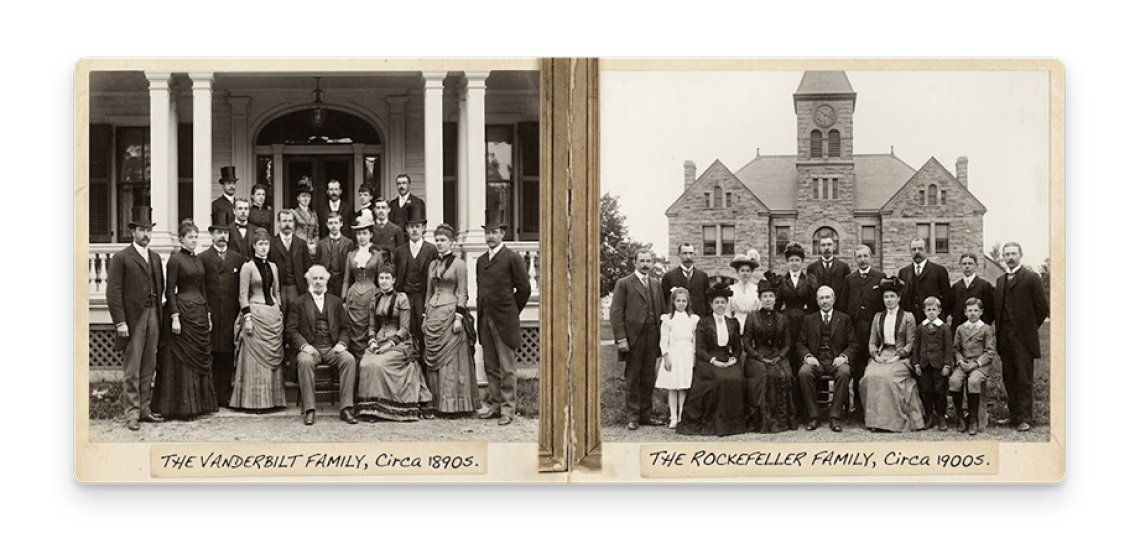
Seven generations later, the Rockefellers are still wealthy. Still influential. Still building.
Same starting fortune. Same era. Completely different outcomes.
The difference is one sentence, written down, that told everyone in the family — and everyone advising the family — what the wealth was for.
That’s what a Legacy Statement is. Not a Hallmark card. The most consequential piece of governance a wealth-holder ever writes.
How You Breathe Life Into It
Writing the sentence is one thing. Making it real is another.
After watching close to 200 members work on theirs, this is where the real work is. Almost everyone can write a first version. It usually happens fast — one honest sentence, sometimes two, in ten minutes. Where people stop is right after. They get a copy of what they wrote, get embarrassed, tuck it in a document, tell themselves they’ll “refine it later” — and it dies. A scratched-out sentence in a notebook that never touches another human being.
That’s the mistake. Here are the four moves that separate the members who make it real from the ones who let it die in a drawer.
1. Read it out loud to someone in your family.
Same principle as last week — held beats pretty. The Legacy Statement doesn’t become real when it’s written. It becomes real when it’s spoken to another person.
It’s going to be awkward. You’ll feel like you’re pitching a company you just started to a room of skeptical investors. Because in a way, you are — you’re aligning the people around you to a mission you’ve just named. But the awkwardness passes, and what replaces it is your spouse or your kids leaning in and asking questions you’ve never had with them before.
2. Use it as a decision filter.
Every time a new investment opportunity, a new expense, a new commitment shows up — ask one question: “Does this move me toward the sentence?”
If yes, engage. If no, pass. That’s what CEOs call a Buy Box — the strict criteria that filter every decision. The Legacy Statement is what fills it. Without it, every decision is a coin flip. With it, most decisions become obvious.
3. Return to it at every planning moment.
Quarterly review — read it out loud before the meeting starts. Annual planning — that’s where you start. Family conversation — make it the anchor.
The Legacy Statement is only powerful if it’s the first reference in every strategic conversation, not the last. When it lives at the top of every meeting, the meeting stays aimed at what actually matters. When it lives in a folder somewhere, the meeting drifts.
4. Let it evolve.
Mine did. The 2016 version — “I want financial independence to spend more time with my family” — was true, but it was general. Over the years it sharpened into what it is now: “To have the time freedom to walk alongside my three sons as they grow into men.”
I didn’t start there. I couldn’t have. The details came from years of reading it out loud, sitting with my wife, watching my kids get older, and letting the sentence grow up alongside the actual life I was building.
The first version is the seed. The refinement is the practice. If yours doesn’t evolve over a few years, you’re not using it enough.
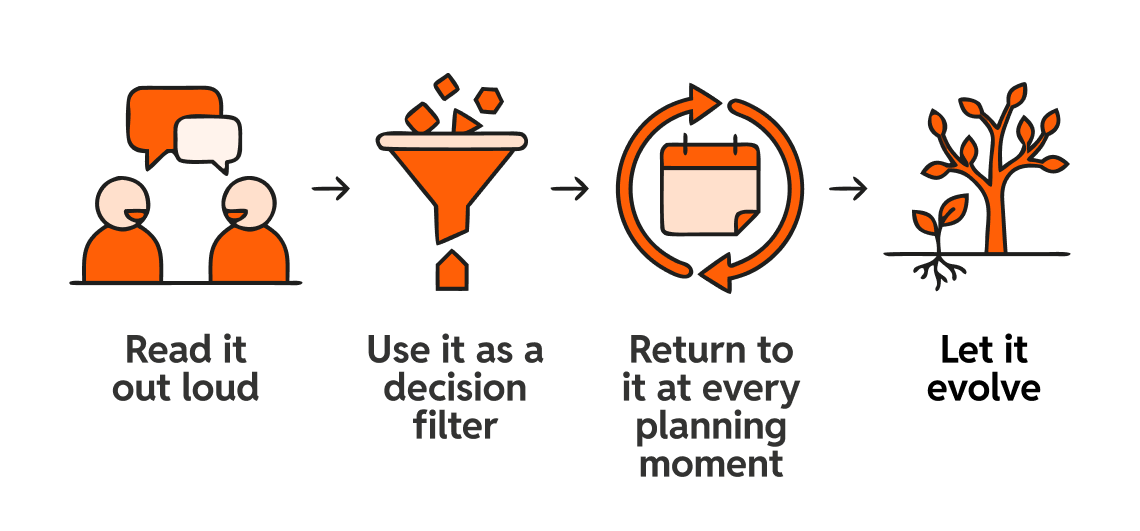
Do those four things and the Legacy Statement stops being a document. It becomes what it’s supposed to be — the operating anchor of every conversation your family has about wealth.
That’s the whole thing. Everything downstream — the entity structures, the portfolio moves, the family governance — gets easier when the anchor is real.
Your One Question This Weekend
Before you write anything, sit with one honest question:
What is your wealth for?
Not what it does for your lifestyle. Not what it provides for your family. What is its greater purpose — the thing beyond comfort, beyond security, beyond the number in the account?
You have to answer that question. Not to me. Not to your advisor. To yourself, out loud, in a quiet moment.
If you can answer it in one sentence — even a messy, imperfect, embarrassing sentence — you have the seed of your Legacy Statement.
Then hold your Family Office meeting this weekend and read it out loud to one person in your family.
That’s the move.
Held beats pretty.
Same principle as last week. The sentence you scratch out imperfectly and read out loud beats the polished one you never share. Because the Legacy Statement’s job isn’t to sit in a document. Its job is to anchor every conversation your family will ever have about wealth — every quarterly review, every big decision, every next-gen conversation your kids will remember decades from now.
That anchor starts with one sentence. Scratched out. Messy. True.
Let’s keep building.
—Christopher
P.S. The Legacy Statement is the first exercise inside The WealthOps Way — our free 2-hour live workshop. If reading this made you want to draft yours with a little scaffolding, that’s the on-ramp. Two hours. Free. You leave with a V1 of your Legacy Statement in hand.
👉 Start here: The WealthOps Way
Go Deeper
🎯 Start here if you’re new — The WealthOps Way Free, 2-hour live workshop. You’ll leave with a V1 of your own Legacy Statement + the foundation for a Micro Family Office.
Recent arc:
The Habit Every Family Office CEO Holds. Most Don’t. — the Family Office meeting with your family
My 2019 Sabbatical Made 2022 Work — how I test-drove my Family Office before committing
I’m Training 170 People to Be Family Office CEOs — the community of practitioners
Today: the sentence that anchors every family conversation
New here?
I’m Christopher. I built my Family Office after my 2012 IPO, spent over a decade studying how it actually works, wrote my first Legacy Statement in 2016, took a sabbatical in 2019 to test-drive the Family Office, went back for more equity in 2020, and walked away from the workforce in 2022. Now I lead the community of practitioners at WealthOps. If this is your first issue — welcome. The best place to start is The WealthOps Way (wealthops.io/go). Free workshop, full framework, no pitch.
This is education, not advice. Learn the systems, don’t copy blindly.

Join me for The WealthOps Way—our free live workshop designed to help you stop guessing and start running your wealth like a business.
You’ll go from scattered to strategic as you craft your own Portfolio Thesis—the foundation of everything that follows.
Spots are limited—and the clarity you’ll gain? Game-changing.
Let’s build your portfolio like it’s your next great company!

If you like the newsletter, support us by letting us know what you think (one click); please do that now!
PS...If you're enjoying Managing Tech Millions, please consider referring this edition to a friend.
If this was useful, tap the ❤️ button. It tells Substack to show more writing like this.
And whenever you are ready, there three ways I can help you:
Follow me on LinkedIn: Get more insights and real-time updates.
Watch on YouTube: Dive deeper into wealth strategies and interviews.
Get in Touch: Ready for a bigger move? Let’s talk.

Disclaimer: This newsletter is for informational purposes only and does not constitute financial or career advice. Always consult with qualified professionals before making any decisions based on the information provided.