

👋 Managing Tech Millions 📈 your go-to source for building wealth with tech equity and managing the money that comes with it.
Every Thursday, we'll deliver a concise and powerful lesson on building wealth working for equity compensation or on managing your seven and eight-figure portfolio.


Today, in 9 minutes or less, you’ll learn:
📊 The 7 components every wealth business needs—and how to score yourself on each one
🎯 Where your biggest gaps are (and what they’re costing you)
🗺️ Your exact next step based on your score—from Reactive to Optimized

Hey Portfolio CEOs,
I spent four years trying to figure out how family offices work.
Read every book.
Talked to Family Office executives.
Tried to reverse-engineer what the ultra-wealthy were doing that I wasn’t.
Then a friend who runs family offices told me something that changed everything:
“It’s not about size, Christopher. Every family office—$10M or $1B—has the same seven components. The only difference is scale.”

Managing Tech Millions is a Weekly Podcast that gives you deep dive conversations into building and growing wealth with myself and other industry experts.
This week, I’m breaking down the 7 core components that every family office runs on—and how you can apply them even if you have $1M to $30M.
The Same Structure as $5B Families: Why family offices all operate on the same foundational components
Scalable at Any Level: How these systems adapt to portfolios far below $100M
From Side Project to System: How to stop “managing accounts” and start running wealth like a business
The 7 Core Components Explained: The framework that powers long-lasting fortunes
Build for Freedom: How to create a self-sustaining wealth system designed for clarity, efficiency, and control

The Pattern Every Family Office Follows
Here’s what I discovered:
Every successful family office—from $25M to $250B—operates through the same seven functional components.
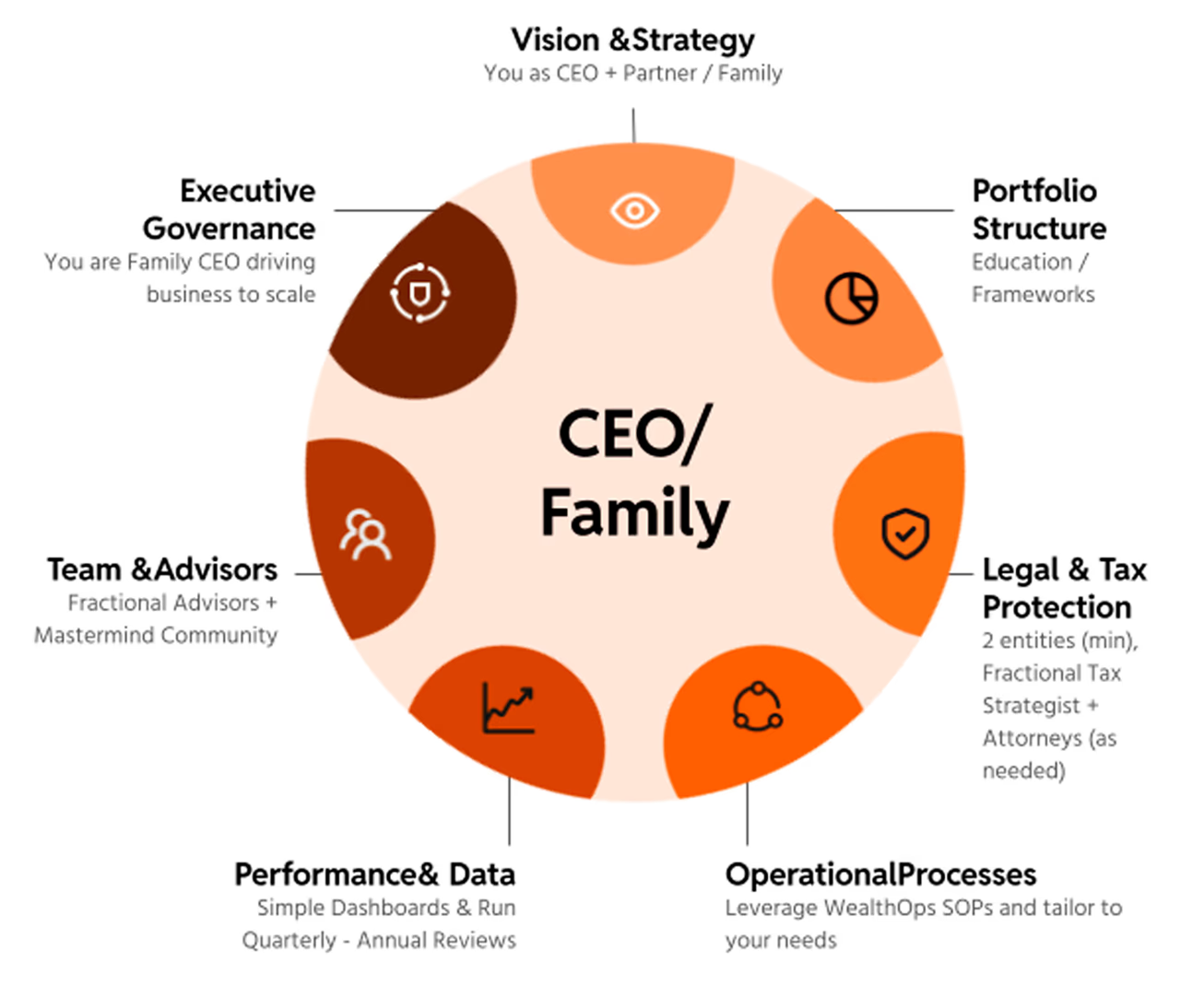
The seven components:
VISION — Your north star (legacy statement, investment thesis)
STRUCTURE — Your portfolio architecture (Evergreen model, allocation, risk management)
PROTECTION — Your defense (entity structures, insurance, asset protection, estate)
PROCESS — Your execution engine (bookkeeping, reconciliation, compliance)
DATA — Your intelligence (dashboard, performance tracking)
PEOPLE — Your specialists (CPA, CTP, attorney, advisors)
GOVERNANCE — Your orchestration (CEO reviews, decision rhythms)
These aren’t random categories. They’re the universal architecture.
The difference between a $10M Micro Family Office and a $500M Single Family Office?
Scale of execution—not the components themselves.
A $500M office has full-time staff reviewing dashboards weekly. A $10M MiFO has fractional specialists reviewing quarterly.
Same components. Different execution scale.
What Each Component Does
Let me break down the role each component plays:
1. VISION (Foundation)
Your wealth’s constitution. Legacy statement defines WHY your wealth exists. Investment thesis defines WHAT you’ll invest in. Decision framework defines HOW you’ll choose.
Without it: Random investments. Conflicting advice. No strategic filter. Cost: $100K+ in misaligned decisions annually.
2. STRUCTURE (Foundation)
Your portfolio architecture. Evergreen model (Income + Growth + Liquidity). Asset allocation framework. Risk management parameters.
Without it: Random allocation. 3-4% underperformance. No systematic approach to building wealth.
3. PROTECTION (Operations)
Your defensive framework. Entity structures (LLCs/trusts). Tax optimization strategies. Insurance coverage. Estate planning.
Without it: 15-25% losses to unnecessary taxes. Lawsuit exposure. Estate disasters. Average cost: $150K+ annually.
4. PROCESS (Operations)
Your execution workflows. Investment procedures. Due diligence checklists. Rebalancing triggers. Documentation standards.
Without it: Every decision from scratch. Missed deadlines. $50K+ in preventable errors. 60 hours monthly managing instead of 12.
5. DATA (Operations)
Your intelligence system. Performance tracking (IRR not balances). Consolidated reporting. Real-time dashboards measuring what matters.
Without it: Flying blind. Can’t measure what you can’t see. $75K in poor decisions from lack of visibility.
6. PEOPLE (Leverage)
Your specialist team. Fractional CPA. Certified Tax Planner. Attorney. Investment partners. Peer network.
Without it: DIY everything. $100K+ in inefficiency. No access to expertise or deal flow.
7. GOVERNANCE (Leverage)
Your CEO orchestration. Weekly/monthly/quarterly/annual review rhythms. Decision frameworks. Strategic planning.
Without it: Complete chaos. Reactive scrambles. $200K+ in opportunity costs. No systematic wealth management.
Here’s the insight most people miss:
All seven components connect. Weak Vision → bad Structure. No Structure → random Protection. Missing Process → Data can’t help. Without People → Governance has nothing to orchestrate.
You can’t skip components. You can only delay the pain.
How I Built Mine
2016: I scored myself on these seven components using the 0-4 maturity scale.
My score: 8 out of 28
I had Vision at Level 1 (thinking about goals, nothing documented). I had Data at Level 1 (tracking balances, not real metrics).
Everything else? Level 0. Reactive chaos.
No Structure: Random allocation across 14 accounts
No Protection: Personal name on everything, paying full taxes
No Process: Sunday scrambles to review positions
No People: Relying on commission-based advisors
No Governance: Reactive chaos, not systematic reviews
The cost of missing components:
Tax inefficiency: $150K+ annually
Time waste: 60 hours monthly
Missed opportunities: $50K from poor execution
Wrong investments: $100K+ in misaligned deals
Total annual cost: $350K+
2016-2017: I built the missing components and operationalized them.
Not perfect. Not optimized. Just operational.
The progression:
Months 1-3 (Level 1-2): Document everything. Vision drafted. Structure defined. Entities formed. Processes documented. Dashboard built. Team hired. Reviews scheduled.
Months 4-6 (Level 2-3): Get family aligned. Walked my wife through the vision. Explained the allocation framework. Showed her the dashboard. Introduced her to the CPA and CTP. She understood what we were building.
Month 7 (Level 3): Operationalize. Vision guided our first investment decision. Rebalanced to hit allocation targets. Ran our first quarterly CEO review with my wife. Team knew their roles.
By August 2017: All 7 components at Level 3 (Structured).
The difference was immediate:
Time: 60 hours monthly → 12 hours monthly
Taxes: $150K saved first year
Decisions: 100 monthly → 10 monthly (batched in reviews)
Confidence: 40% → 90%
Same portfolio. Better infrastructure. Completely different experience.
2018-2026: The system scaled as my portfolio grew.
I didn’t rebuild. I optimized what already existed. Foundation stayed stable. Operations got more efficient. Leverage grew stronger.
That’s the power of having all 7 components in place.
The Diagnostic: Which Component Is Your Weakest?
Most people building a MiFO have some components documented (Level 1-2) but struggle to operationalize them (Level 3-4).
The gap: Creating artifacts isn’t enough. You need to get your family aligned and use them systematically.
Use this scorecard to identify where you’re stuck:
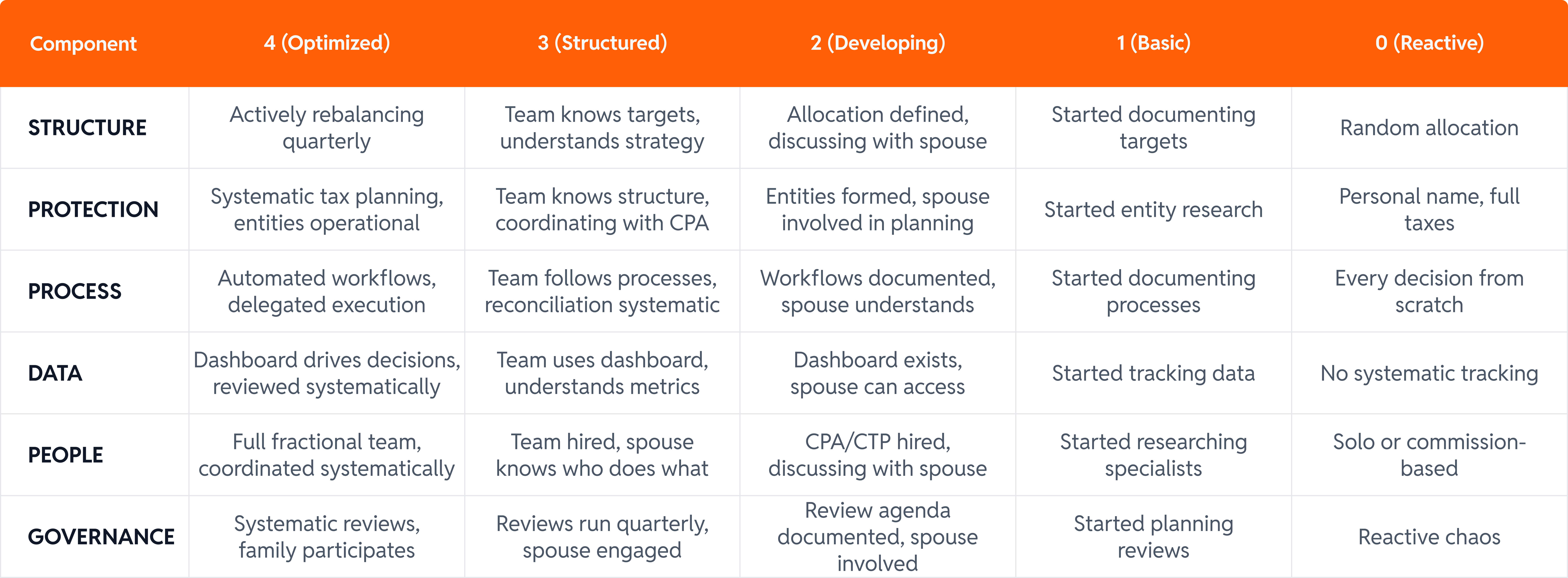
Your total score (out of 28):
21-28: Operational MiFO (Structured to Optimized)
14-20: Components documented, working toward operational (Developing)
7-13: Foundation started, need to operationalize (Basic)
0-6: Pre-MiFO, need documentation (Reactive)
The critical insight:
Most people score 7-14 (Basic to Developing). You’ve created some documents, but you’re not using them. Your family doesn’t know about them. Your team isn’t aligned.
That’s the gap this program closes.
What to do based on your weakest component:
Stuck at Level 0-1 (VISION)? Start documenting. Draft your legacy statement. Get something on paper this week.
Stuck at Level 0-1 (STRUCTURE)? Define your allocation framework. Document your Income/Growth/Liquidity targets.
Stuck at Level 0-1 (PROTECTION)? You’re losing $100K-$300K annually to taxes. Research entity structures and hire a CTP.
Stuck at Level 2 (any component)? Get your spouse/partner involved. Walk them through what you’ve documented. Start the alignment process.
Stuck at Level 2-3 (any component)? Focus on operationalization. Move from “we have it” to “we use it systematically.”
The Maturity Path: How Components Evolve
Your components don’t need to be perfect. They need to be present.
Stage 1: Builder ($1M-$5M) Foundation components exist (Vision + Structure). Basic Operations starting (Protection + Process). Governance is you running quarterly reviews.
Stage 2: Operator ($5M-$15M) Full Operations layer (Protection + Process + Data all functional). Beginning to build Leverage (People fractionally hired, Governance rhythms established).
Stage 3: Scaler ($15M-$30M) Complete system. All 7 components optimized. Advanced Leverage (full fractional team, sophisticated Governance).
Build sequentially. Don’t skip stages.
A $2M portfolio doesn’t need Scaler-level complexity. A $20M portfolio can’t operate with Builder-level infrastructure.
Right-sized implementation beats premature optimization.
What I Learned
The 7-component model isn’t theory.
It’s how every successful family office operates—$10M to $10B.
You don’t need $100M to justify this infrastructure. You need the right systems at the right scale.
All 7 components don’t need to be perfect. But all 7 need to be operational.
Better to have all 7 at Level 3 (Structured) than 3 at Level 4 (Optimized) with 4 missing.
Here’s what most people miss:
Creating documents (Level 1-2) isn’t enough. You need to get your family aligned (Level 3) and use the frameworks systematically (Level 4).
I see this pattern constantly: People create a legacy statement, put it in a folder, and never reference it again. That’s Level 1.
Level 3 means your spouse knows it. Your kids have heard it. Your advisor references it in meetings.
Level 4 means every investment opportunity gets filtered through it.
The transformation happens at Level 3+.
Build sequentially: Foundation → Operations → Leverage.
Skip steps = rebuild everything later.
Your Action This Week
Take the Component Scorecard above. Score yourself honestly across all 7 components.
Identify your weakest component.
That’s where you start.
Not with what’s easy. Not with what’s interesting. With what’s missing.
You’re the CEO of a wealth business. Act like it.
—Christopher
P.S. When I scored 8 out of 28 in 2016, I felt behind. Then I realized: most people with my portfolio size scored 0-7. They were compensating for missing infrastructure through personal heroics—60+ hours monthly managing wealth instead of building it. The real insight? Most people who score 7-14 have created documents but haven’t operationalized them. Their families don’t know the vision. Their teams aren’t aligned. That’s where the transformation happens—Level 3, when you move from artifacts to operations.
This is education, not advice. Learn the systems, don’t copy blindly.

Join me for The WealthOps Way—our free live masterclass designed to help you stop guessing and start running your wealth like a business.
You’ll go from scattered to strategic as you craft your own Portfolio Thesis—the foundation of everything that follows.
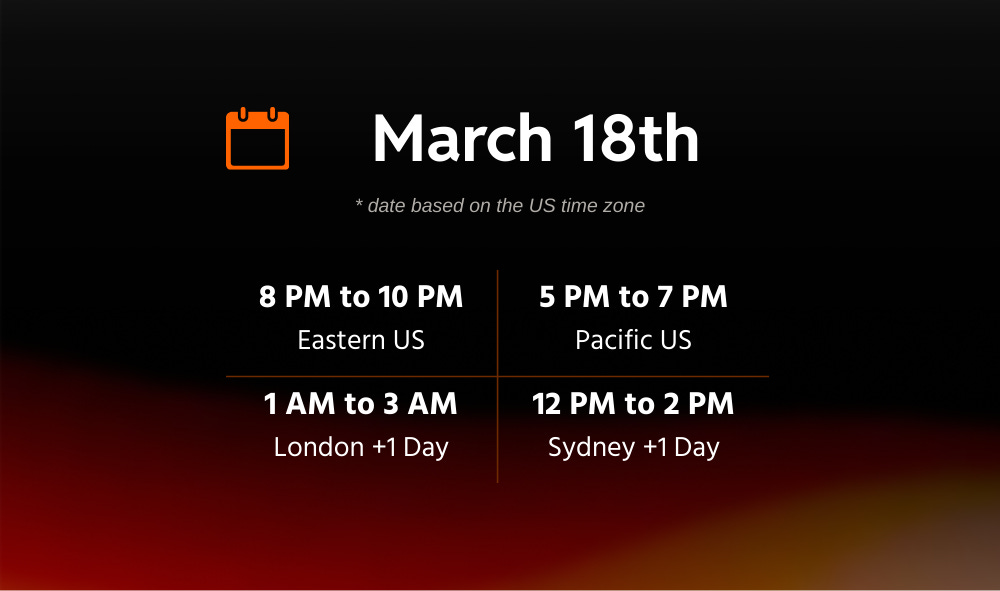
Spots are limited—and the clarity you’ll gain? Game-changing.
Let’s build your portfolio like it’s your next great company!

If you like the newsletter, support us by letting us know what you think (one click); please do that now!
PS...If you're enjoying Managing Tech Millions, please consider referring this edition to a friend.
And whenever you are ready, there three ways I can help you:
Follow me on LinkedIn: Get more insights and real-time updates.
Tune into the Podcast: Dive deeper into wealth strategies and interviews.
Get in Touch: Ready for a bigger move? Let’s talk.

Disclaimer: This newsletter is for informational purposes only and does not constitute financial or career advice. Always consult with qualified professionals before making any decisions based on the information provided.