


👋 Managing Tech Millions by WealthOps 📈 your go-to source for building wealth with tech equity and managing the money that comes with it.
Every week, we'll deliver a concise and powerful lesson on building wealth working for equity compensation or on managing your seven and eight-figure portfolio.


Today, in 5 minutes or less, you’ll learn:
🌍 The 2023 family decision that changed how I thought about our Values Charter forever
⚖️ The operating rule my wife and I discovered — the one that makes hard decisions easy
🗺️ The one move to make this weekend to draft your V1

Hey Family Office CEOs,
A few weeks ago I told you about the Legacy Statement — the one sentence that gives your family’s wealth a purpose. The most important document you’ll ever write.
Today I want to tell you about the second document — the one that pairs with the Legacy Statement and completes what we call the Family Office thesis.
It’s your Values Charter. And I want to show you what it looks like when it actually works — through a real decision my family made in 2023 that I still think about.

Managing Tech Millions is a Weekly Podcast that gives you deep dive conversations into building and growing wealth with myself and other industry experts.
This week, I’m breaking down why I walked away from the 4% rule and retired at 51 with half the portfolio my peers had—and why I’m still out-earning them in cash flow four years later.
The 1994 problem: The 4% rule assumes average markets, so retiring into a bad one forces you to sell at the bottom to pay your bills.
The financial services desert: Under $1M you get index funds, over $100M you get a family office, and everyone between $1M and $30M gets a cookie-cutter portfolio and a 1% fee.
The third category: Growth and preservation are what every advisor talks about. Income is what lets you stop selling assets to fund your life.
The number that let me walk: 47% of my portfolio in income assets, throwing off $175K a year against $150K of family expenses.
Good year, bad year: Same $3M, same 60/40, same 4% withdrawal, and the year you happen to retire decides whether you triple your money or end up smaller than when you started.
Where to start: Assess your current split, unwind concentration over 12 to 24 months, deploy $50K-$100K into income assets, then build the entity and reporting structure around it.

The Uganda Decision
Summer 2023. School break coming up. Family conversation about where we should go.
The obvious option: Disneyland. Every kid wants it. We could afford it easily. It’s the kind of trip that says “we made it, we can enjoy it, we’re financially free.”
And that’s exactly why we started to hesitate.
We caught ourselves in a pattern. We were making choices around freedom — we could go anywhere, do anything, spend on what we wanted. But the more we sat with the choice, the more one question surfaced: how is any of this actually impacting the next generation? What’s the legacy we’re leaving?
That question got answered by the document we’d written back in 2016.
We looked at our Values Charter — the five values my wife and I had spent years refining down to what actually mattered to us: Legacy, Freedom, Service, Education, Impact. And we looked at what the Disneyland trip would activate versus what an alternative would activate.
We flew to Uganda instead. Service trip. The whole family. Life-changing — for our kids, for our marriage, for what we all understood about what wealth is actually for.
At the end of the trip, we asked our sons a direct question: “Did we make the wrong choice?”
They said no. They agreed with us. They saw the choice for what it was.
That’s when I realized what a Values Charter actually does — and why it’s just as important as the Legacy Statement it pairs with.
Where Values Actually Come From
Before I get to what happened in that Uganda decision at the mechanical level, let me tell you where we got our five values from — because this is where most people get stuck when they try to write theirs.
Our values didn’t come from a list of things that sounded good. They came from our lived experience — what we learned from our parents and grandparents, what actually helped us be successful at work, the moments that shaped who we became. My wife and I each showed up with our own experiences, our own frames, our own hierarchy. When we first sat down to write our Values Charter in 2016 — the same weekend we did our Legacy Statement — our values were divergent.
That’s fine. That’s normal. Over the years of working together, sitting with each other’s frames, and running our family through actual decisions, our lists converged and simplified. Not because either of us abandoned what mattered — because the values that were shared proved themselves in real practice.
That’s the important part. Your values come from your experience. If you’re writing a Values Charter with a spouse, expect divergence at first. Trust the convergence that happens through practice.
The Operating Rule We Discovered
Here’s the thing about values that almost no one names: a list of values without a hierarchy is a wish. A hierarchy of values is governance.
Because in real life, values conflict. Freedom conflicts with Service. Legacy conflicts with immediate impact. Education conflicts with cost. When two values collide, something has to win. If you haven’t decided in advance, you decide in the moment — and in the moment, the easier value almost always wins.
Here’s the operating rule my wife and I discovered — and it’s the thing that made the Uganda decision easy:
When two values are activated, they outweigh a competing single value.
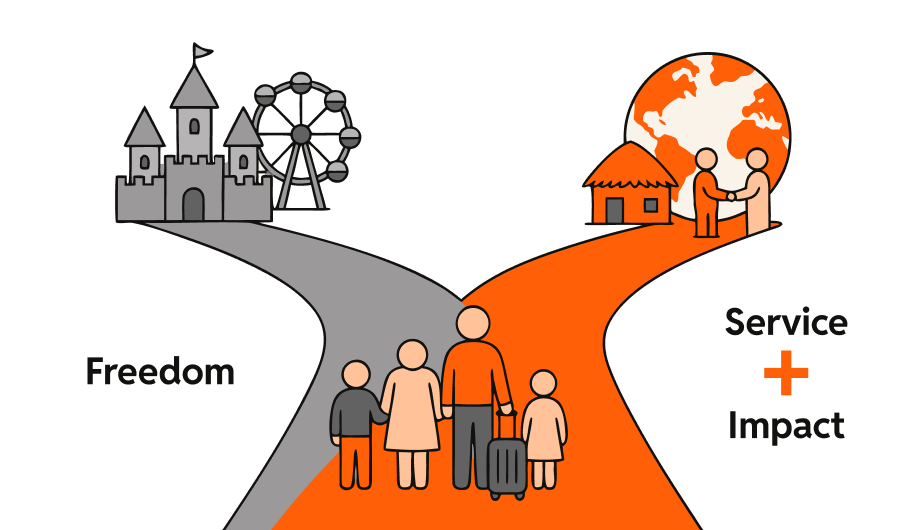
Look at Uganda vs. Disneyland through this rule:
Disneyland activated Freedom — the freedom to spend on what we wanted, to enjoy what we’d built
Uganda activated Service + Impact — service to the community there, impact on our kids, impact on what our wealth was actually accomplishing
Two values on one side. One on the other. The Charter made the call.
Once we had the rule, the decision stopped being hard. It became mechanical — in the best way. We weren’t wringing our hands over “the right thing to do.” We were reading the Charter, seeing the math, and moving.
That’s what a Values Charter actually produces: hard decisions made easy, because the framework already did the deciding.
Why the Kids Moment Mattered Most
Here’s the part I didn’t expect — and it’s the piece I want you to see most.
The kids saw something you can’t teach any other way.
They saw us use money to make a real impact — to help people, to spend our capital on service that mattered to a community that needed it. They made friends with people whose lives looked nothing like theirs. And they experienced firsthand, in real time, what happens on the other side of that kind of choice: that when you use wealth for impact, life is very rich — in a way that gratification alone can’t produce.
That was the most powerful observation I made from the whole trip. It wasn’t the service work itself. It was watching my sons realize — not from a lecture, not from something we told them, but first-hand — that wealth used for impact makes life rich in a way that spending on ourselves never does. Rich in relationships. Rich in perspective. Rich in what money can actually accomplish when you point it somewhere that matters.
That’s the return most people never think to design their wealth around. You can’t teach it from a Thanksgiving speech. You can’t teach it from a Values Charter on a wall. You teach it by making the choice in front of them — and letting them experience the other side of what wealth aimed at impact actually feels like.
That’s the compounding return of a Values Charter that’s actually used. Every decision it drives becomes a lesson the next generation can see, feel, and carry forward.
What Separates Members Who Use It Operationally
I see the pattern clearly across close to 200 members in the community — with more joining every month.
The members whose Values Charter works aren’t the ones with the most sophisticated document. They’re the ones who:
Write it down in a form they can reference
Read it out loud to their family and their team
Ask to be held accountable to living it
Have real conversations about it — when it drives a decision, when it should have driven a decision but didn’t, when a value needs sharpening
The members whose Charter doesn’t work usually wrote a list once, tucked it somewhere, and never read it again. Same discipline problem as every other governance document. Held beats pretty. Read out loud beats read once.
The families who use their Values Charter operationally build cohesive family cultures around how they manage their wealth. The ones who don’t stay in the same conversations they’ve been having for years — with no new answers, because there’s no framework to answer with.
Your Move This Weekend
Sit down for 30 minutes. Bring a notebook or open a doc.

Write your top five values. With one hard rule: they have to come from your experience.
What did your parents or grandparents teach you that actually stuck?
What helped you become successful at work — not the tactical skills, but the underlying values?
What do you aspire to be that you’re not fully yet?
Get to five. Not ten. Not fifteen. Five, because a hierarchy of five is manageable — and a list of twenty is a wish.
Then — the harder part — rank them. Which one wins when it’s up against another? If two of them are activated in a real decision, do those together outweigh the third?
That’s the seed of your Values Charter. Same rules as the Legacy Statement: held beats pretty. The messy V1 you actually draft beats the perfect one you never write.
Legacy Statement + Values Charter = your Family Office thesis.
The Legacy Statement names the why. The Values Charter names the how. Together they anchor every real decision your family will ever make about wealth — and they’re the pair every real Family Office is built on.
Most families never write either one. The ones I’ve watched become real Family Offices always write both.
Let’s keep building.
—Christopher
P.S. If reading this made you want to draft yours — The WealthOps Way is the two-hour live workshop where I walk through the first document (your Legacy Statement) live. The full build — the Legacy Statement + Values Charter as your Family Office thesis, plus the Family Office Blueprint that pairs with them, plus the Cadence and BUILD Business Plan — is inside the Micro Family Office Accelerator, Year 1 of the WealthOps membership.
👉 Start here: The WealthOps Way
Go Deeper
🎯 Start here if you’re new — The WealthOps Way Free, 2-hour live workshop. The foundation for the Family Office thesis (Legacy Statement + Values Charter).
The structured build path: Micro Family Office Accelerator — Year 1 of the WealthOps membership. Where close to 200 members are practicing this right now.
Recent arc:
The Member Note That Stopped Me This Week — the income breakthrough and the “Zen Calm” of coverage
3 Things This CXO Got Right Building His Family Office — three practices that actually work
My First Legacy Statement Was 11 Words — the why document
Today: the how document that pairs with it
New here?
I’m Christopher. I built my Family Office after my 2012 IPO, wrote my first Legacy Statement in 2016 (and my Values Charter that same weekend with my wife), moved to Madrid with my family this summer, and now lead a community of close to 200 practitioners at WealthOps. If this is your first issue — welcome. The best place to start is The WealthOps Way (wealthops.io/go). Free workshop, full framework, no pitch.
This is education, not advice. Learn the systems, don’t copy blindly.

Join me for The WealthOps Way—our free live workshop designed to help you stop guessing and start running your wealth like a business.
You’ll go from scattered to strategic as you craft your own Portfolio Thesis—the foundation of everything that follows.
Spots are limited—and the clarity you’ll gain? Game-changing.
Let’s build your portfolio like it’s your next great company!

If you like the newsletter, support us by letting us know what you think (one click); please do that now!
PS...If you're enjoying Managing Tech Millions, please consider referring this edition to a friend.
If this was useful, tap the ❤️ button. It tells Substack to show more writing like this.
And whenever you are ready, there three ways I can help you:
Follow me on LinkedIn: Get more insights and real-time updates.
Watch on YouTube: Dive deeper into wealth strategies and interviews.
Get in Touch: Ready for a bigger move? Let’s talk.

Disclaimer: This newsletter is for informational purposes only and does not constitute financial or career advice. Always consult with qualified professionals before making any decisions based on the information provided.