


👋 Managing Tech Millions by WealthOps 📈 your go-to source for building wealth with tech equity and managing the money that comes with it.
Every week, we'll deliver a concise and powerful lesson on building wealth working for equity compensation or on managing your seven and eight-figure portfolio.


Today, in 5 minutes or less, you’ll learn:
📊 What he did right — the disciplined way he redesigned his portfolio (and what most people get wrong)
🧭 The “Zen Calm” insight — what income does emotionally that Growth never can
🗺️ The one calculation to do this weekend to find your coverage number

Hey Family Office CEOs,
I got a note from a member of the community this week that I want to share with you. It’s exactly the kind of update that reminds me why we built this.
Five months into the program. He started with very little monthly portfolio income — mostly Growth-heavy, the classic Problem Portfolio pattern. He shifted his approach, ran the framework, and shared what he called a “Win report” this week:
Monthly portfolio income has crossed $20K per month starting in August (dividends and ETFs)
Next target: $50K per month in the next 90 days (dividends, ETFs, and Wheeling Options)
All of it being reinvested so compounding can do its miracle
And the line that stopped me: “There is a certain Zen Calm that arrives when aiming for the Evergreen + 150% coverage of your overhead and seeing it come to fruition.”
(A quick note: his outcomes are his. Results vary depending on the person, the situation, the timeline, and a lot of other factors. What matters here isn’t copying his exact instruments — it’s understanding the discipline underneath what he did.)
That last line — the Zen Calm one — is what I want to unpack. But first I want to call out what he did right in his approach, because it’s the part most people miss when they try to make a similar shift.

Managing Tech Millions is a Weekly Podcast that gives you deep dive conversations into building and growing wealth with myself and other industry experts.
This week, I’m breaking down the 3-phase blueprint I used to escape the financial dead zone, and why the order of those phases matters more than any single strategy.
The $50,000 Question: On a $5M portfolio, 1% in fees buys you the same 90/10 allocation your advisor hands someone with $100K in a 401(k).
The Financial Dead Zone: Retail finance stops at $1M and family offices start at $100M, so everyone in between builds their own infrastructure or gets nothing.
Architect Before You Invest: Your Legacy Statement and Investment Thesis come first. Every allocation decision after that is implementation.
Build the Machine: Entity structure, fractional specialists (tax strategist, estate attorney, bookkeeper), and a tech stack that keeps your operating costs down.
Run It Like a Business: Written investment processes, a monthly-quarterly-annual review cadence, and rules-based rebalancing instead of emotional buying and selling.
Don’t Skip to Phase 3: Most people jump straight to the deals. Without the foundation underneath, that shortcut comes back to bite them.

What He Did Right — Built On What He Already Knew
Here’s the discipline underneath the result. It’s the part I want you to see even more than the numbers.
He didn’t chase private equity or exotic strategies he didn’t understand. He looked for income instruments that aligned with the stock vehicles he already knew — dividends, ETFs, covered call strategies (Wheeling Options). He built off his existing knowledge and strength.
Most people, when they hear “shift from Growth to Income,” reach for the highest-yielding, most complicated thing they can find — usually private equity or private credit — because those numbers sound the biggest.
He did the opposite. He looked at income tools within his current expertise and mastered those first. Deeper competence in what he already knew, before expanding into territory he didn’t.
This is one of the things I say all the time inside the community: you build off your strengths. You expand into unfamiliar territory only after you’ve squeezed the return out of what you already know.
The Other Half — He Had a Clear Plan
Building off his strengths mattered. But so did the second half of his discipline: he had a clear plan.
He knew, before he made a single move:
What type of investments he wanted to transition into
How he wanted to balance the risk across the portfolio
How he wanted to ensure everything aligned with his overall thesis
What his position sizing rules were
He didn’t wait to see what happened. He engineered for a specific outcome — and then built to it.
That’s the difference between wishful thinking and an operating plan. A clear plan means you know what your results should look like before you make the moves — so you can hold yourself accountable to whether you’re actually getting there.
What $20K/Month Actually Represents
With that discipline underneath it, the numbers start to make sense.
Five months ago, he had very little monthly income — mostly Growth. That’s the Problem Portfolio: high net worth on paper, zero cash flow, everything aimed at more appreciation.
Today: $20,000 a month in dividends and ETFs. That’s $240K/year in portfolio income — real cash landing in real accounts, without touching principal. His next target — $50K/month in the next 90 days — would put him at $600K/year.
And here’s the shift most people miss. He didn’t do this by making his portfolio bigger. He did it by redesigning what the portfolio was for. Same wealth, restructured to produce income instead of just accumulate value.
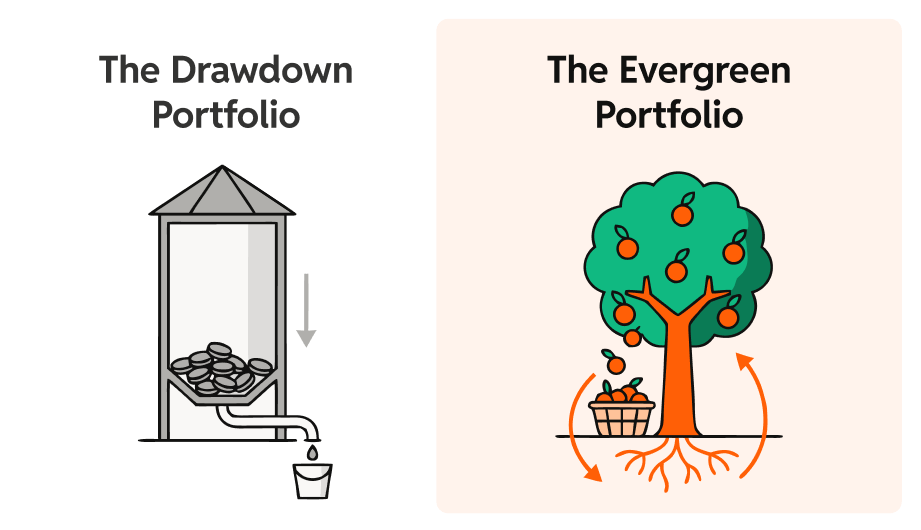
That’s what the Evergreen model is. That’s what happens when the Legacy Statement produces hard requirements (the “$175K number” teaching from a few weeks ago) and the portfolio gets architected — with a clear plan, built off familiar instruments — to hit them.
The Zen Calm
Let me stay on that phrase for a minute, because it’s the part of his note that stopped me cold.
“There is a certain Zen Calm that arrives when aiming for the Evergreen + 150% coverage of your overhead.”
Here’s what I think he means. Most wealth builders spend their entire career in a specific kind of anxiety: the anxiety of extraction. If I stop working, my income stops. If the market crashes, my net worth crashes. If I want to spend, I have to sell something.
That anxiety doesn’t go away with more wealth. It goes away with coverage — the moment your portfolio produces enough income to cover your life (and then some) without depleting the principal.
150% coverage of overhead means the portfolio is producing 1.5× what you need to live. Every check that lands is 50% more than you need — the excess reinvests, compounds, and grows the income engine further. It’s a machine that gets stronger the longer you leave it alone.
That’s what produces the Zen Calm. Not the size of the number. The structural relationship between what you produce and what you need. When production is 1.5× consumption, everything else becomes optional — the job, the timing, the geography, the pace.
That’s the emotional reality of an Evergreen portfolio. Almost no one names it. He did.
What He Did That Most People Don’t
Here’s the part of his note I want to sit with:
“I started to shift my thoughts about Income and Growth prior to starting WealthOps, but taking the program certainly helped accelerate and refine my process.”
He was already moving. The program didn’t create the shift — it accelerated it. It gave him the framework to name what he was doing, refine the specifics, and put structure around it.
That’s what the Accelerator is. Not magic. Not a shortcut. A scaffolded build that takes the intuition you already have and turns it into an operating framework you can actually run.
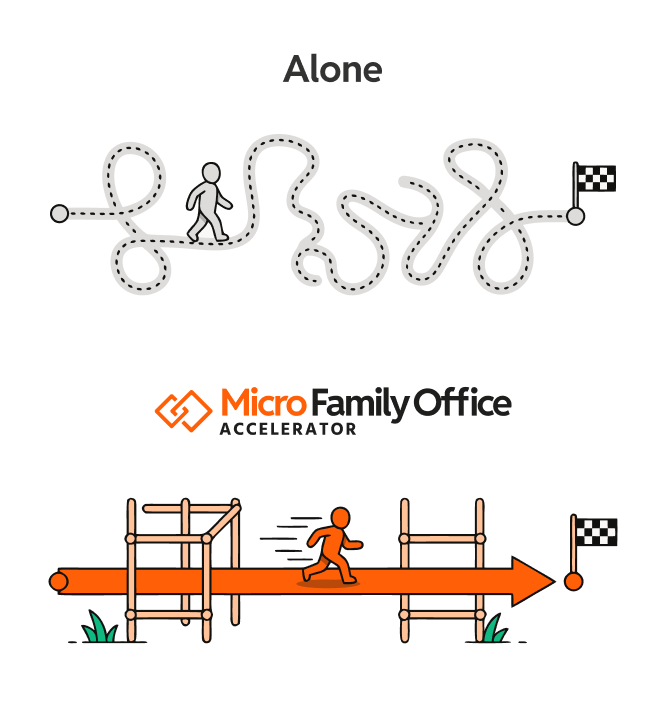
Most people spend years in the “start to shift my thoughts” phase — reading, thinking, moving in the right direction but not building the structure. The ones who accelerate are the ones who put the framework in place and start running it. That’s the difference between a five-year discovery arc and a five-month breakthrough.
Where This Lives in the Program
Everything in this member’s story maps to specific deliverables members build inside the Micro Family Office Accelerator:
The redesign from Growth to Income — built as the Investment Thesis and Portfolio Architecture (two of the four documents in the Family Office Blueprint). Members shift their asset categorization from “what appreciates” to “what pays.”
The Evergreen framework — the model that says your portfolio should produce distributions rather than deplete principal. Taught across the ARCHITECT and BUILD phases.
The 150% coverage target — the operational math that turns income from a nice-to-have into a hard requirement. Built as part of the goals framework members set inside their Blueprint.
This is what the membership actually produces: a Family Office where the portfolio is designed to pay you, not just grow. Not theoretical. Not aspirational. Operational.
Your One Calculation This Weekend
Stop reading and open the numbers. Answer three questions:
What’s my current monthly portfolio income? (Distributions, dividends, interest — cash that lands without selling anything.)
What’s my monthly overhead? (Real living expenses, not the aspirational version.)
What’s my ratio? (Income ÷ overhead. If you’re at 0.5× you have a Problem Portfolio. If you’re at 1.0× you’re work-optional. If you’re at 1.5× you have the Zen Calm coverage this member is aiming for.)
Write the three numbers down. That’s your baseline. Everything downstream — the portfolio moves, the reallocations, the timeline to independence — starts from knowing where you actually are today.
The member above went from very little to $20K/month in five months. Not by getting richer. By redesigning what his portfolio was for.
Held beats pretty.
Same principle as always. The messy first calculation you actually do beats the perfect one you never finish. Get to your baseline this weekend. Then start moving.
The Zen Calm is on the other side of the math.
Let’s keep building.
—Christopher
P.S. If reading this made you think “I want mine to look like his” — here’s the path. The WealthOps Way is the two-hour live workshop where I walk through your first Legacy Statement and the shape of what a Family Office actually looks like. The full build — the Family Office Blueprint (including the Investment Thesis and Portfolio Architecture that redesigned this member’s portfolio), the Cadence, the BUILD Business Plan — is inside the Micro Family Office Accelerator, Year 1 of the WealthOps membership.
👉 Start here: The WealthOps Way
Go Deeper
🎯 Start here if you’re new — The WealthOps Way Free, 2-hour live workshop. The foundation for the shift this member made.
The structured build path: Micro Family Office Accelerator — Year 1 of the WealthOps membership. Where close to 200 members are practicing this right now.
Recent arc:
3 Things This CXO Got Right Building His Family Office — a member family’s three practices
6 Tax Teams in Spain. One Pattern Was Undeniable. — the framework travels
The $175K Number That Rewrote My Portfolio — the income engine that produces the coverage
Today: a member’s $20K/month breakthrough and the “Zen Calm” of the Evergreen model
New here?
I’m Christopher. I built my Family Office after my 2012 IPO, moved to Madrid with my family this summer, and now lead a community of close to 200 practitioners at WealthOps. If this is your first issue — welcome. The best place to start is The WealthOps Way (wealthops.io/go). Free workshop, full framework, no pitch.
This is education, not advice. Learn the systems, don’t copy blindly.

Join me for The WealthOps Way—our free live workshop designed to help you stop guessing and start running your wealth like a business.
You’ll go from scattered to strategic as you craft your own Portfolio Thesis—the foundation of everything that follows.
Spots are limited—and the clarity you’ll gain? Game-changing.
Let’s build your portfolio like it’s your next great company!

If you like the newsletter, support us by letting us know what you think (one click); please do that now!
PS...If you're enjoying Managing Tech Millions, please consider referring this edition to a friend.
If this was useful, tap the ❤️ button. It tells Substack to show more writing like this.
And whenever you are ready, there three ways I can help you:
Follow me on LinkedIn: Get more insights and real-time updates.
Watch on YouTube: Dive deeper into wealth strategies and interviews.
Get in Touch: Ready for a bigger move? Let’s talk.

Disclaimer: This newsletter is for informational purposes only and does not constitute financial or career advice. Always consult with qualified professionals before making any decisions based on the information provided.