


👋 Managing Tech Millions by WealthOps 📈 your go-to source for building wealth with tech equity and managing the money that comes with it.
Every week, we'll deliver a concise and powerful lesson on building wealth working for equity compensation or on managing your seven and eight-figure portfolio.


Today, in 4 minutes or less, you’ll learn:
🏦 The tool progression that turned his kids into active co-operators over years of practice
🎯 The one insight underneath it — why his kids don’t inherit responsibility; they earned it
🗺️ The one move to make this weekend, at whatever age your kids actually are

Hey Family Office CEOs,
A member’s practice with his kids stopped me cold.
I won’t share his name. I’ll share what he’s done — because it’s the single clearest example I’ve seen of what next-generation engagement actually looks like when it’s practiced over decades, not just talked about at Thanksgiving.
Here’s the compressed version: his kids started with a piggy bank when they were young. They’re in their 20s today, and they now bring investment opportunities to him for the family portfolio. They participate in the portfolio reviews with the outside professionals who manage part of the family’s wealth.
That didn’t happen because he handed them a manual when they turned 18. It happened because he handed them the right tool at every age — and evolved the tool as they evolved.

Managing Tech Millions is a Weekly Podcast that gives you deep dive conversations into building and growing wealth with myself and other industry experts.
This week, I’m breaking down the difference between a portfolio you consume and a portfolio that pays you—and why the 4% rule was never designed for the wealth you’re building.
The Drawdown Trap: A 4% withdrawal means you liquidate principal every year and pay full freight on the taxes.
Assets That Operate: Stop building a pile of money and start running an income system on private real estate, private credit, and energy.
The Tax Layer: Depreciation shields and depletion allowances explain why two portfolios with the same yield don't keep the same income.
What $20M+ Families Hold: TIGER 21 puts 70% into private equity, real estate, and private credit, and 20% into public equities.
Your Micro Family Office: The four components that bring family office operations down to a $1M-$30M portfolio.

The Tool Progression
He started decades ago with something almost embarrassing in its simplicity:
A piggy bank.
Not a fancy 529. Not a trust document. A physical piggy bank on a shelf, with money going in, money coming out, and a father having conversations with young kids about what happened to each dollar.
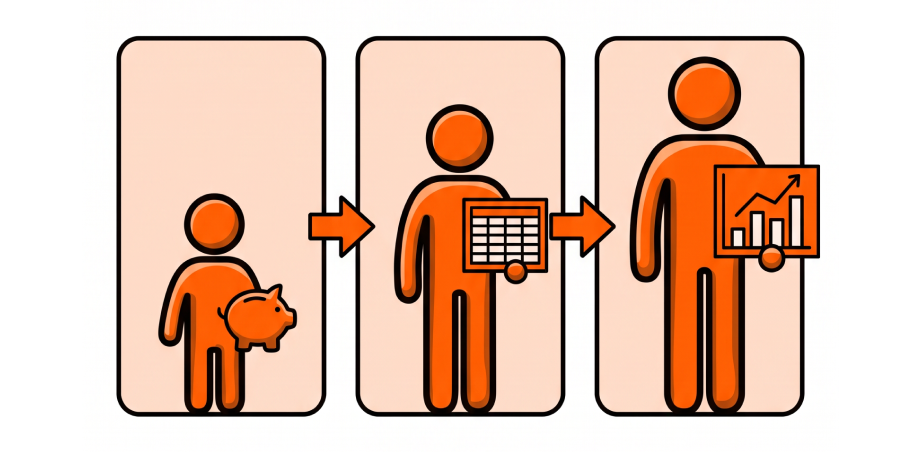
As the kids got older, the piggy bank became a spreadsheet. They could see totals. They could add rows. They could ask questions the piggy bank couldn’t answer — “why is this bigger than last month?” — and get real answers.
As they got older still, the spreadsheet became a brokerage account. Real dollars. Real decisions. Real consequences. Interest they could see, dividends they could name, positions they could research.
The tool changed. The practice didn’t.
Every conversation — piggy bank at 6, spreadsheet at 12, brokerage at 18 — carried the same underlying question: “What’s happening to the money, and why?” The tool was just the vehicle for the conversation the family kept having, year after year.
What That Progression Produced
His kids are in their 20s now. Here’s what that decades-long practice actually built.
They still reference the original teaching. He told the community that his grown kids will refer all the way back to the piggy bank when they talk about interest compounding. The framework got installed early enough that it became native — the way a first language is native. They don’t think about compounding as a concept they had to learn. They think about it as something they’ve always understood.
They frame investment opportunities for him. Not passively receive them. He recently mentioned a family meeting where the agenda included two investment ideas — one he brought to the family, and one his kids brought to him. They researched it. They structured it. They brought it forward for the family’s consideration. That’s not “let me teach you how to think about investing.” That’s “here’s what I’ve been evaluating — let’s look at it together.”
They sit in the portfolio reviews with the outside manager. Not as observers. As participants. When the family’s outside advisor does the quarterly performance walk-through, all the kids are there. Asking questions. Pushing on assumptions. Making the review sharper than it would be if only the parent were in the room.
And here’s the tell that told me most: the outside advisor firm — the traditional professionals who’ve managed a piece of the family’s wealth for years — is starting to feel the shift. The kids being in the room, asking sharper questions, bringing sharper ideas, is challenging the old model. The whole family is graduating out of what a conventional advisory relationship can offer, because the whole family is now sophisticated enough to see past it.
That’s what decades of the right tool at the right age produces. Not passive inheritors. Active co-operators. Not a handoff at 50. A shared operation the family has been running together since the kids were in grade school.
Why This Actually Works
Here’s the insight underneath the tool progression.
His kids don’t inherit responsibility. They earned it — progressively, through years of practice.
Most families think of generational transfer as a one-time event. A trust that vests at 25. A conversation at 30. A meeting with the estate attorney when someone turns 40. A handoff.
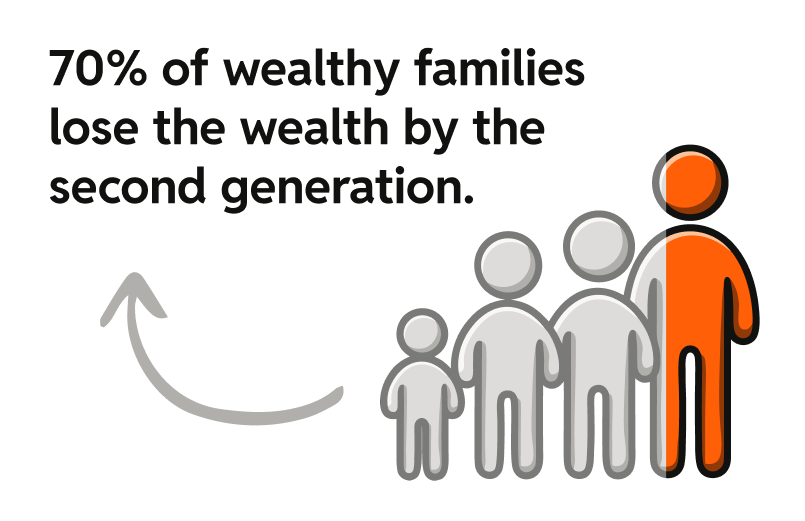
That model has a problem. The Williams Group studied 3,200 wealthy families and found that 70% of them lose the wealth by the second generation, and 90% by the third. The cause of the failure was almost never technical planning — it was the absence of prepared heirs and shared operating practice across generations. In other words: the handoff model doesn’t work. It never has.
What this member did instead: he built the practice before there was anything to hand off. When the piggy bank had $12 in it, they were already having the conversation about what money does. When the spreadsheet had four rows, they were already learning to ask the right questions. When the brokerage account had a small starter balance, they were already making real decisions with real consequences.
By the time there was something meaningful to steward, they’d been stewarding smaller things for 15 years. The handoff wasn’t a handoff. It was just the next entry in a practice that never stopped.
That’s the model. Not “they’ll figure it out when they inherit.” Not “we’ll teach them when they’re older.” Start where they are. Match the tool to the age. Keep the conversation going. Let the tool evolve alongside them.
The technical stuff — trusts, entities, estate structures — matters. But it matters around the practice, not instead of it. Structures without practice is exactly the Williams Group failure pattern. Practice with structures is the Rockefeller pattern.
Key Takeaways
Generational transfer isn’t an event. It’s a decades-long practice. The families who preserve wealth across generations are the ones who started when the kids were young and never stopped.
Match the tool to the age. Keep the conversation the same. Piggy bank at 6, spreadsheet at 12, brokerage at 18 — the tool evolves; the underlying question (”what’s happening to the money, and why?”) doesn’t.
Kids who steward small things become adults who steward big ones. Active co-operators aren’t produced by inheritance. They’re produced by years of practice with real consequences at appropriate scales.
Your One Move This Weekend
Don’t try to install a decades-long practice this weekend. Start where your kids actually are, with the right tool for their age.
If your kids are young (6 to 12): get a piggy bank or a jar on a shelf. Have real conversations about what goes in, what comes out, and why. Show them the math when there’s math to show. The dollar amounts are trivial. The practice is not. The conversation you have when there’s $8 in the jar is the same conversation you’ll be having when there’s $80,000 in the account.
If your kids are teens (13 to 18): open a shared spreadsheet or a custodial brokerage account. Let them see real numbers. Give them a small budget to allocate — even $500 — and ask them what they’d do if it were theirs. Let them defend the answer. Let them make a mistake at this scale so they don’t make it at a bigger one later. The tuition of a $500 lesson is much cheaper than the tuition of a $50,000 one.
If your kids are young adults (18 to 30): invite them to your next family financial conversation. Not to observe. To participate. Give them one thing to research and bring back with a recommendation — an investment idea, an entity structure question, a tax opportunity. Let them present it. Let them get pushed on it. This is where “next-gen education” stops being a phrase and starts being a practice.
If your kids are older adults (30+): take a phased approach — gauge their engagement before you open the full picture.
Start with the vision. Share the Legacy Statement. Talk to them about the big why — what you’re building the wealth to accomplish, what mattered enough to turn this into a real business, where the family is going over the next generation.
Then give directional information, regularly. How’s the family doing this quarter? What are the big decisions coming up? What are you thinking through? Not the raw numbers yet — the direction and the intent. Watch what they engage with. Watch what they ignore. Watch what they push back on.
Then start opening the numbers. Once they’re actively engaged — asking questions, weighing in, showing up to conversations you didn’t have to pull them into — start bringing in the actual investment work. Walk them through the Family Office Blueprint. Ask them to weigh in on a real decision.
Don’t skip the phases. Some adult kids will move through them in a month. Some will take years. Both are fine — the pacing has to match their genuine engagement, not your ideal timeline. Meet them where they are. Let engagement pull the opening forward.
If they’ve never been in this conversation before, the early phases will feel uncomfortable. Hold them anyway. The awkwardness passes. The relationship deepens.
One move. This weekend. At the age they actually are. That’s how decades of practice start — one tool, one conversation, one week at a time.
Where This Fits in the Program
The next-generation engagement work is one of the most powerful pieces of what members build inside the Micro Family Office Accelerator. It’s part of the Cadence — the family conversations you build into your quarterly rhythm — and it’s part of the BUILD Business Plan — the operating structure that includes how you’re preparing the next generation.
The member above didn’t build any of this in isolation. The Cadence gave him the rhythm. The Family Office thesis gave him the framework. The community gave him the reference points from other families doing the same work.
Kids in their 20s framing investments for their parents isn’t magic. It’s a decades-long practice, built on a system that evolves with the family.
Held beats pretty.
Same principle as always. The piggy bank on the shelf that you actually use beats the fancy custodial account you set up and forget. Start where they are. Evolve the tool as they evolve. Never stop the conversation.
That’s how a Family Office actually outlasts you.
Let’s keep building.
—Christopher
P.S. If reading this made you think “I want to start this practice with my kids” — here’s the path. The WealthOps Way is the two-hour live workshop where I walk through the foundation of the Family Office thesis (your Legacy Statement and the shape of what a Family Office actually is). The full build — the Cadence that runs the family conversations, the Family Office Blueprint that gives them something to inherit, the BUILD Business Plan that includes the next-gen work — is inside the Micro Family Office Accelerator, Year 1 of the WealthOps membership.
👉 Start here: The WealthOps Way
Go Deeper
🎯 Start here if you’re new — The WealthOps Way Free, 2-hour live workshop. The foundation members build the next-gen practice on.
Recent arc:
We Chose Uganda Over Disneyland. Here’s Why. — the Values Charter that made the decision easy
The Member Note That Stopped Me This Week — the income breakthrough and the “Zen Calm” of coverage
3 Things This CXO Got Right Building His Family Office — three practices that actually work
Today: the multi-decade next-gen practice one member has been running
New here?
I’m Christopher. I built my Family Office after my 2012 IPO, moved to Madrid with my family this summer, and now lead a community of close to 200 practitioners at WealthOps. If this is your first issue — welcome. The best place to start is The WealthOps Way (wealthops.io/go). Free workshop, full framework, no pitch.
This is education, not advice. Learn the systems, don’t copy blindly.

Join me for The WealthOps Way—our free live workshop designed to help you stop guessing and start running your wealth like a business.
You’ll go from scattered to strategic as you craft your own Portfolio Thesis—the foundation of everything that follows.
Spots are limited—and the clarity you’ll gain? Game-changing.
Let’s build your portfolio like it’s your next great company!

If you like the newsletter, support us by letting us know what you think (one click); please do that now!
PS...If you're enjoying Managing Tech Millions, please consider referring this edition to a friend.
If this was useful, tap the ❤️ button. It tells Substack to show more writing like this.
And whenever you are ready, there three ways I can help you:
Follow me on LinkedIn: Get more insights and real-time updates.
Watch on YouTube: Dive deeper into wealth strategies and interviews.
Get in Touch: Ready for a bigger move? Let’s talk.

Disclaimer: This newsletter is for informational purposes only and does not constitute financial or career advice. Always consult with qualified professionals before making any decisions based on the information provided.