


👋 Managing Tech Millions by WealthOps 📈 your go-to source for building wealth with tech equity and managing the money that comes with it.
Every week, we'll deliver a concise and powerful lesson on building wealth working for equity compensation or on managing your seven and eight-figure portfolio.


Today, in 5 minutes or less, you’ll learn:
📊 The failure mode that kills 85% of family wealth — and why nobody in the wealth-preservation industry names it clearly
🎯 The 5-level ladder I’m using to grade every family member on their readiness — from “they’ll find out from a lawyer” to “they participate in the decision”
🗺️ The one move to make this weekend to run the assessment and pick your first level-up

Hey Family Office CEOs,
Here’s a stat that should reorganize your Q4.
The Williams Group studied 3,200 wealthy families across generations and found something almost nobody in this industry talks about.
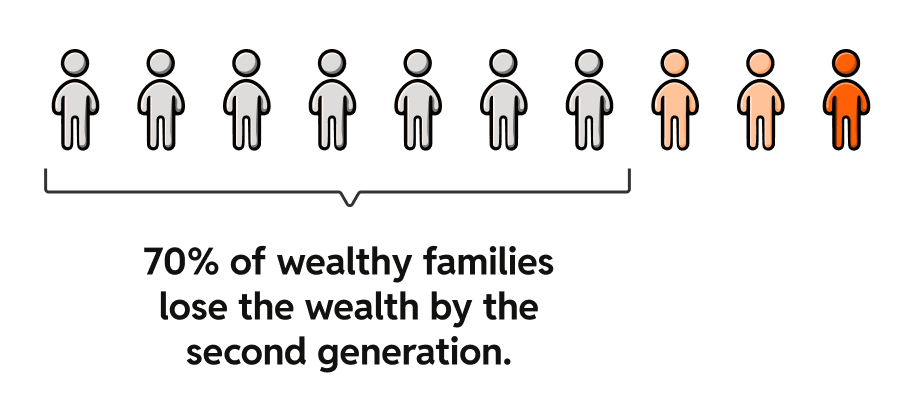
70% of those high-net-worth families lose their wealth by the second generation. 90% by the third. Every wealth-preservation firm cites those numbers.
But almost nobody cites the next line — the one that actually tells you where the failure comes from.
Of the families that fail:
85% fail on communication and unprepared heirs.
Only 5% fail on technical planning — bad structure, bad tax work, bad investments.
Read that again. Communication is 17 times more likely to sink your family’s wealth than any structural, tax, or investment mistake you could make.
And it’s exactly the thing every Family Office CEO I know — myself included, for years — spends the least time working on.

Managing Tech Millions is a Weekly Podcast that gives you deep dive conversations into building and growing wealth with myself and other industry experts.
This week, I’m breaking down the 7 components every family office runs on—and why the $100 million entry point was never the real requirement.
Three Models, One Seat: Single, multi, and micro family offices run on the same principles. Only one puts you in the CEO seat.
Structure Kills the Junk Drawer: Sort what you own into growth, income, and capital preservation, then write the investment policy that governs it.
The Two-Company Architecture: The Vault holds your assets. The Engine runs your operations and opens up the Deduction Stack.
Process Is the Base of the Pyramid: Clean books first, then documents, tax, and cash. Portfolio decisions sit at the top for a reason.
Two Scoreboards: Market performance is outside your control. Business effectiveness is fully inside it.
Governance Stays With You: Delegate the bookkeeping and the filings. Strategic decisions and family alignment are the CEO's job.

Where the Money Actually Goes to Die
Here’s the honest picture.
Most Family Office CEOs I talk to are spending their planning cycles on the 5% side. Better entities. Better tax structures. Better trust arrangements. Better investment allocations. All of it necessary. None of it saves you from the 85%.
I’ve been guilty of this myself in the early years. The structural work is easier — there’s a specialist for every piece, the moves are concrete, and you can measure whether you did them. The communication work has none of that. There’s no CPA to hand it to. No entity to file. No date on the calendar that says “today you did the communication.”
And the work of engaging the family isn’t easy. It’s hard. Many times we’re talking to children who have no formal business or wealth training, and trying to engage them in a serious conversation.
For families whose children are grown — and have their own ideas about business and wealth — it can be even harder.
So it doesn’t happen. Or it happens ad hoc. Or it happens all at once, in a panic, at a hospital bedside or a legal deposition or the reading of the will.
And that’s exactly how the 85% loses the wealth. Not because the trust was drafted wrong. Because the family walked into the moment of transfer with no shared vocabulary, no context, no rehearsal, and no readiness for the operator role they suddenly held.
The failure isn’t structural. The failure is that most CEOs never built a framework for how to read their family into the picture, and so the family found out about the picture the way strangers do.
The Binary Trap Almost Everyone Falls Into
Here’s the reframe I want to plant.
Most CEOs I talk to think about family communication in binary terms. “Either the books are open — everyone sees everything, we’ve told the kids the total number, they know the entities, they know the plan — or they’re closed and I’ll handle it later.”
That binary is the trap.
There isn’t a two-position switch. There’s a ladder. And every family member sits somewhere on that ladder right now, whether you’ve been intentional about it or not. The question isn’t “do I open the books or not” — it’s “where is each family member today, and what’s the next rung I want to move them to before I sit down at the annual review?”
I built this ladder out live on a recent community call after one of our members had a mic-drop moment describing the full transparency she has with her adult daughter — how her daughter now knows everything about the portfolio, participates, contributes. It was the clearest picture I’d seen of the destination. What most of us don’t have is the path.
So here’s the path. Five levels, starting from zero.
The 5-Level Family Communication Ladder
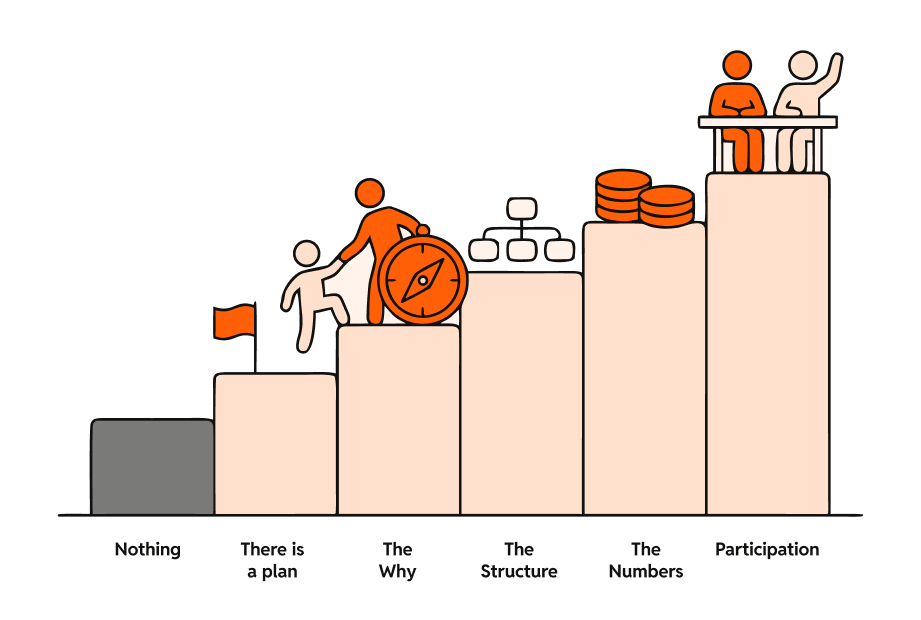
Level 0 — Nothing. Outside of yourself, no one knows anything. If you’re hit by a bus tomorrow, your family finds out from a lawyer. This is where the 85% statistic actually lives — the families who never left Level 0 for anyone.
Level 1 — There is a plan. People know a plan exists. That’s it. “I’m building this thing called a family office. It’ll matter. I’ll tell you more over time.” No numbers. No structure. Just the existence of intention. There’s a little bit of marketing here — you’re planting the flag that this is real and being built deliberately.
Level 2 — The Why. The purpose. The Legacy Statement. What this wealth is actually for — the mission it’s serving, the impact you’re building it toward, the values the family stands on. This is the most important level, and it’s the one where almost all the real work sits. No numbers still. If you skip this level and jump to Level 3 or 4, everything downstream lands wrong — the family sees the money and the structure without understanding what any of it is for, and the wealth becomes about consumption instead of contribution.
The rule I hold with this: people should always get the why before they get the what, and the what before they get the numbers. In that order. Not reversed.
Level 3 — The Structure. Now the informational inventory. Here are the entities. Here’s how assets are stored. Here’s the shape of the family office as a business. Still no dollar figures required — just the operational picture. This is where a family member becomes fluent in how the family office runs without yet being read in on how much is inside it.
Level 4 — The Numbers. The dollar figures. Not always all at once. My move in my own family right now is that we’re actively looking at reading in on portions — the whole inventory becomes visible, then we start giving numbers on the small pieces first, especially the ones a specific family member is going to manage or own. Start with the pieces they’ll be operating, not the aggregate. The aggregate lands better once the operator role is already familiar.
Level 5 — Participation. They’re in the room. They vote. They bring investment ideas forward. They defend positions. They own outcomes. This is where our member from the mic-drop moment lives with her adult daughter — full transparency, real participation, a working co-operator instead of an eventual inheritor.
Why This Belongs in Your Q4
Two reasons.
One: your Annual Review — the four-area review I wrote about last week — has a People pillar. This ladder is the operator mechanic for the family half of that People Review. Every family member gets a grade — 0 through 5 — and every family member gets one deliberate level-up move planned for the next 12 months.
Two: every year you don’t do this, the 85% risk compounds. The family gets older without getting more prepared. The wealth grows without the readiness growing with it. Then one day — a health event, a market shock, a transition — the wealth transfer moment arrives, and the family walks into it at the same level they were at ten years ago.
Structural planning without communication planning is exactly what the 85% did. Don’t join the 85%.
Key Takeaways
The failure mode isn’t the one you’re planning against. Only 5% of families fail on technical planning. 85% fail on communication and unprepared heirs. You’re 17× more likely to lose the wealth to the second problem than the first.
The binary trap kills more families than bad trusts do. “Open books or closed books” is the wrong frame. There’s a 5-level ladder, and every family member sits somewhere on it right now — whether you were deliberate about it or not.
Why → What → Numbers. In that order. Skip Level 2 and everything downstream lands wrong.
The Annual Review is where you assess and level-up. Every family member gets a grade this Q4. Every family member gets one intentional next rung planned for the coming year.
Your Move This Weekend
Two moves. Both small. Both this weekend.
One: grade every family member on the ladder.
List every family member the family office will eventually affect. Spouse, kids, siblings if relevant, nephews/nieces if you’re reading them in. Next to each name, write a number — 0, 1, 2, 3, 4, or 5. Don’t overthink it. First-instinct grades are usually right.
Two: pick one level-up move for one family member — the one you’d most benefit from moving up one rung.
Not the whole ladder for everyone. One move. One person. The next 12 months, executed deliberately.
If they’re at 0 and you don’t know why they’re still at 0 — that’s your move. Just get them to Level 1 by end of year. “I’m building this thing. It matters. I’ll share more over time.”
If they’re at 2 and you’ve never actually read them the Legacy Statement out loud — that’s your move. Do it before Thanksgiving.
If they’re at 3 and they’ve never seen even a small numbers picture — that’s your move. Pick one small piece and read them in.
One person. One rung. Named this weekend. Executed by the annual review. That’s how you get on the right side of the 85%.
Held beats pretty.
The trust document you’re perfecting won’t save your family from the 85% failure. The level-up you plan this weekend might.
Move your family forward. Move your family office forward.
Let’s keep building.
—Christopher
P.S. The 5-level ladder, the four-area Annual Review, the Family Office CEO approach that ties them together — all of it is inside the operator system we teach at the Micro Family Office Accelerator. If reading this made you think “I’ve been building the structure without doing the communication work” — you’re not alone, and you’re not too late. The WealthOps Way is the place to start.
👉 Start here: The WealthOps Way
Go Deeper
🎯 Start here if you’re new — The WealthOps Way Free, 2-hour live workshop. Where the operating cadence starts.
Recent arc:
The Annual Review I Run Every Q4 — 4 Areas, 1 Lens — the Q4 operator framework this ladder plugs into
By 2030 AI Runs Your Wealth. Here’s the Trap. — the prediction and the rule that keeps you on the right side of it
A Piggy Bank at 6. Real Investment Picks at 26. — the multi-decade next-gen practice
Today: the 5-level ladder for reading your family in — because 85% of wealth fails on communication, not on tax
New here?
I’m Christopher. I built my Family Office after my 2012 IPO — after googling “how to build a family office” and hitting the $100M wall the industry has quietly agreed on. Moved to Madrid with my family this summer. Now lead a community of more than 230 practitioners at WealthOps, and we’re building Eterna, the AI platform behind our approach. If this is your first issue — welcome. The best place to start is The WealthOps Way (wealthops.io/go). Free workshop, full rulebook, no pitch.
This is education, not advice. Learn the systems, don’t copy blindly.

Join me for The WealthOps Way—our free live workshop designed to help you stop guessing and start running your wealth like a business.
You’ll go from scattered to strategic as you craft your own Portfolio Thesis—the foundation of everything that follows.
Spots are limited—and the clarity you’ll gain? Game-changing.
Let’s build your portfolio like it’s your next great company!

If you like the newsletter, support us by letting us know what you think (one click); please do that now!
PS...If you're enjoying Managing Tech Millions, please consider referring this edition to a friend.
If this was useful, tap the ❤️ button. It tells Substack to show more writing like this.
And whenever you are ready, there three ways I can help you:
Follow me on LinkedIn: Get more insights and real-time updates.
Watch on YouTube: Dive deeper into wealth strategies and interviews.
Get in Touch: Ready for a bigger move? Let’s talk.

Disclaimer: This newsletter is for informational purposes only and does not constitute financial or career advice. Always consult with qualified professionals before making any decisions based on the information provided.