


👋 Managing Tech Millions by WealthOps 📈 your go-to source for building wealth with tech equity and managing the money that comes with it.
Every week, we'll deliver a concise and powerful lesson on building wealth working for equity compensation or on managing your seven and eight-figure portfolio.


Today, in 5 minutes or less, you’ll learn:
📊 Why paying a percentage of your assets costs more, and fits worse, as your wealth grows
🎯 My prediction for that fee model by 2032, and why I’ll sign it
🗺️ The one sentence to write this weekend about what your advice actually costs

Hey Family Office CEOs,
In 2012, right after my IPO, I took one meeting with Morgan Stanley.
A senior advisor and a junior advisor sat down across from me. About 90% of my net worth was in a single stock. I asked how we’d handle the concentration. I asked about unwinding it slowly and offsetting the taxes. I asked how they’d work with my CPA, and whether I needed an entity structure.
They slid a proposal across the table. 60/40 stocks and bonds. Their answer to the concentration was to sell half when my blackout period ended and turn it over to them.
When I asked them to walk me through the thinking, the answer was, “This is just how we do it.”
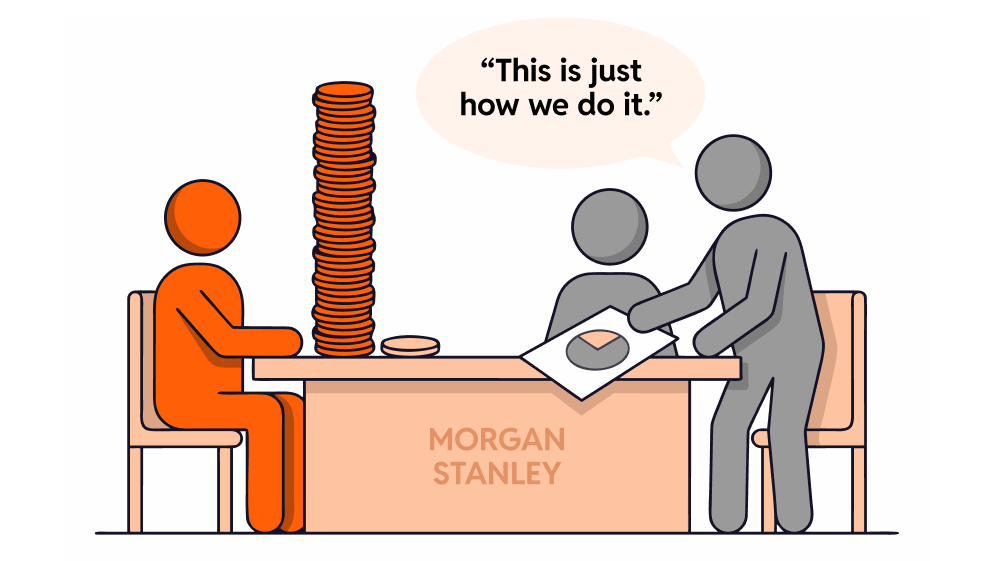
I walked away. I’d been managing my own investments for over a decade before the IPO, and I kept doing it. Years later, I can see that meeting showed me how the fee model works.
Today I’m putting a bet on the record.

Managing Tech Millions is a Weekly Podcast that gives you deep dive conversations into building and growing wealth with myself and other industry experts.
This week, I’m breaking down how to unwind a concentrated stock position—and the four-step system I used to turn 90% of my net worth in one company into cash I needed and a position I chose to keep.
Concentration Builds, Diversification Preserves: Your company stock and the rest of your wealth have two different jobs. If your paycheck comes from the same company, you’re exposed twice, and that’s why concentration can feel safe even when it isn’t.
Two Goals, Not One Question: “Should I sell?” pushes you toward all or nothing. Start with an after-tax cash goal for the money you need out and a holding goal for the position you keep on purpose.
When the Goals Don’t Fit: Sometimes the shares above your holding line won’t cover your cash goal. Then you have to decide whether to speed up or give yourself more time, and you need to know exactly how far off you are.
Don’t Let the Tax Tail Wag the Dog: Taxes should shape how you sell, never whether you reach your goal. I cover the three levers to work through with your tax planner, and why April is too late for that conversation.
What the Private Bank Told Me: Right after my first IPO, a big private bank gave me their answer for my position. I’ll tell you what they said, why I didn’t follow it, and what I built instead.
A Plan You Run Every Quarter: I set targets in Q4 and sold steadily from January, window by window. That rhythm takes the guessing and the emotion out of selling, and it keeps new vests from quietly rebuilding the pile.

The Belief
Most people with real wealth are taught a simple path. Make money, find a big firm, hand over the portfolio, pay around 1% a year.
That’s called assets under management, or AUM. The advisor’s fee is a percentage of the money they hold for you.
At a few hundred thousand dollars, that can be a fair trade. You get a disciplined portfolio and someone to keep you from panic-selling. Plenty of good advisors work this way, and plenty of families are well served by it.
But the math changes as the number grows.
Where the Fee Model Breaks
At $5 million, the advisory fee alone often runs around 0.75%, or $37,500 a year. Add the fund and platform costs layered underneath, and the all-in cost commonly lands at 1% or more. That’s $50,000 a year, and at least half a million dollars over ten years, before you count what that money would have grown into.
The incentive is the bigger problem.
An AUM fee is paid on the assets the advisor holds. So the advice is shaped, even with good intentions, toward keeping assets on the platform. Look at the moves that come up again and again once a family reaches $5 million and up:
Private real estate and private equity, held directly or through funds the advisor doesn’t manage
A Holding Company that owns the portfolio
Paying down debt, or buying a business
Building income from assets that sit somewhere else
Every one of those moves money off the platform. Under a percentage fee, every one of them is a pay cut for the person advising you.
That’s what I saw across the table in 2012. I don’t think anyone in that room was a bad person. They were offering the product their model was built to sell, and it was the same for nearly everyone who walked in.
I knew what they were offering, and I knew it wasn’t what I wanted, so I never made that choice.
My Prediction
By 2032, paying a percentage of your assets for advice will be functionally obsolete for families with $5 million or more.
The firms will still be here. But the families who understand what they’re buying will stop paying for advice this way, and at this level the percentage-of-assets model will become the exception.
Three reasons I’ll sign it.
1. Education is spreading. For a long time, people with $5 million didn’t know what else to ask for. That’s changing. Every family that learns how the fee works starts asking what they’re paying for.
2. The right strategy at this level lives off the platform. The tactics the ultra-wealthy use, like private investments, entities, and income from assets, don’t fit inside a fee tied to the portfolio an advisor holds.
3. The replacement already exists. Family offices have always paid specialists for specific work: a tax planner for tax, an attorney for structure, an investment specialist for a mandate. In my early years, I worked with fee-only advisors for planning, paid for the advice itself, and kept making the investment decisions myself.
AI accelerates all three. When the operations and reporting get cheaper and the education gets easier to find, a percentage of everything gets harder to defend.
What Replaces It
Advisors stay in this picture, in a different role.
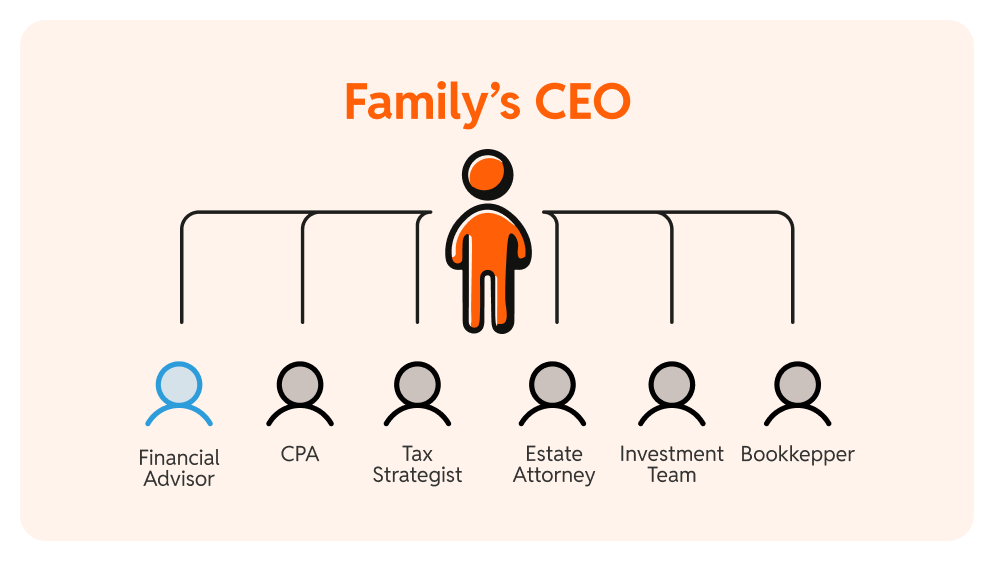
The family’s CEO sits in the leadership seat. Specialists join the team and get paid for the job they do: a flat fee, a project fee, an hourly rate, a retainer. Some of the best advisors you’ll ever work with will still be on that team. You’ll just know exactly what you’re paying each of them for.
It’s one of the core principles of how the ultra-wealthy operate: CEO Mindset: You Lead, Experts Execute.
Key Takeaways
A percentage fee grows with your wealth, whether or not the work does. At $5 million, an all-in cost of 1% is $50,000 a year.
The incentive points toward the platform. The strategies that matter most at this level move money off it.
My bet: by 2032, families with $5 million or more stop paying for advice as a percentage of assets. Specialists, paid for specific work, replace it.
Your Move This Weekend
Add up every dollar you paid for financial advice in the last 12 months. Advisory fees, planning fees, fund-level fees you can find. Look at your statements for the dollar figure, not the percentage.
Then finish one sentence:
“For $___ a year, I get ___.”
Be specific about the second blank. Investment management? Tax coordination? Planning? Education? A call when the market drops?
If the sentence reads well, you have a good arrangement, and that’s worth knowing. If it’s hard to finish, you’ve found your first conversation for 2027.
Completion signal: the sentence is written, with a real dollar figure in it.
Held beats pretty.
I’ve put this one on the record. Check back with me in 2032.
Let’s keep building.
—Christopher
P.S. Learning what each part of your wealth costs, and who on your team you’re paying for what, is a big part of what members build inside the Micro Family Office Accelerator. If you want to see how a family office team fits together, start with The WealthOps Way.
👉 Start here: The WealthOps Way
Go Deeper
🎯 Start here if you’re new — The WealthOps Way Free, 2-hour live workshop.
The structured build path: Micro Family Office Accelerator — Year 1 of the WealthOps membership.
Recent arc:
I Walked Away From Operators Who Were Making Me Money — the pro forma and my own underwriting
3 Things I Learned From Years in Private Equity — why, where to start, and vetting the operator
By 2030 AI Runs Your Wealth. Here’s the Trap. — AI as your operations manager, not your decision maker
Today: my prediction for the percentage-of-assets fee model
New here?
I’m Christopher. I built my Family Office after my 2012 IPO, after googling “how to build a family office” and hitting the $100M wall the industry has quietly agreed on. Now I lead a community of more than 240 practitioners at WealthOps, and we’re building Eterna, the AI platform behind our approach. If this is your first issue, welcome. The best place to start is The WealthOps Way (wealthops.io/go). Free workshop, full rulebook, no pitch.
This is education, not investment advice. Every situation is different. Work through your own arrangements with your advisors.

Join me for The WealthOps Way—our free live workshop designed to help you stop guessing and start running your wealth like a business.
You’ll go from scattered to strategic as you craft your own Portfolio Thesis—the foundation of everything that follows.
Spots are limited—and the clarity you’ll gain? Game-changing.
Let’s build your portfolio like it’s your next great company!

If you like the newsletter, support us by letting us know what you think (one click); please do that now!
PS...If you're enjoying Managing Tech Millions, please consider referring this edition to a friend.
If this was useful, tap the ❤️ button. It tells Substack to show more writing like this.

And whenever you are ready, there three ways I can help you:
Follow me on LinkedIn: Get more insights and real-time updates.
Watch on YouTube: Dive deeper into wealth strategies and interviews.
Get in Touch: Ready for a bigger move? Let’s talk.

Disclaimer: This newsletter is for informational purposes only and does not constitute financial or career advice. Always consult with qualified professionals before making any decisions based on the information provided.