


👋 Managing Tech Millions by WealthOps 📈 your go-to source for building wealth with tech equity and managing the money that comes with it.
Every week, we'll deliver a concise and powerful lesson on building wealth working for equity compensation or on managing your seven and eight-figure portfolio.


Today, in 5 minutes or less, you’ll learn:
📊 The three year-one operating mistakes I see most often — and why each one looks right at the time
🎯 Why “understand, then delegate” beats “delegate from day one”
🗺️ The one audit to run this weekend that surfaces all three

Hey Family Office CEOs,
A member pulled his books back in-house.
He’d been paying an outside firm to handle the operations of his family office — the closing, the reconciliation, the monthly numbers. And a few months into building his structure, he ended the arrangement and started closing the books himself, with his spouse.
His reason wasn’t that anything had gone wrong. It was that he didn’t understand how the machine worked — and he wasn’t comfortable handing off something he couldn’t explain.
When he told the group on a recent implementation call, a few people winced. Isn’t that backwards? Isn’t the whole point to get out of operations?
It is. I’ve written that myself — get more out of your operations and spend less time there, so you can lead the wealth and build your successors.
But here’s the part people skip. You can’t delegate what you don’t understand. And almost every Family Office makes the same three operating mistakes in its first year because of it. I made the first one myself.

Managing Tech Millions is a Weekly Podcast that gives you deep dive conversations into building and growing wealth with myself and other industry experts.
This week, I’m breaking down what a Micro Family Office actually is—and why the structure the Rockefellers built in 1882 works on a $1 million portfolio.
Not a New Idea: Noble families hired majordomos in the sixth century and the Rockefellers built the first single family office in 1882, both for the same three jobs—grow it, protect it, pass it on.
Where You Actually Fit: Single family office starts at $100 million, multi-family office covers $30 to $100 million, and micro family office is the tier built for $1 to $30 million in investable assets.
The Conversation That Started It: After my first IPO, the CIO of a single family office worth billions showed me a structure that didn’t exist at my level, so I scaled it down to the components that actually drive the results.
Artifacts Over Accounts: An investment thesis and a legacy statement govern the decisions that scattered spreadsheets never could.
Five Core Functions: Wealth management, business operations, partner management, family governance and education, and lifestyle design and philanthropy—the same universe the big offices run, scaled to what you need.
Who Should Not Build One: Plenty of people want to keep climbing in their career and don’t want the CEO seat, and that’s a legitimate answer.

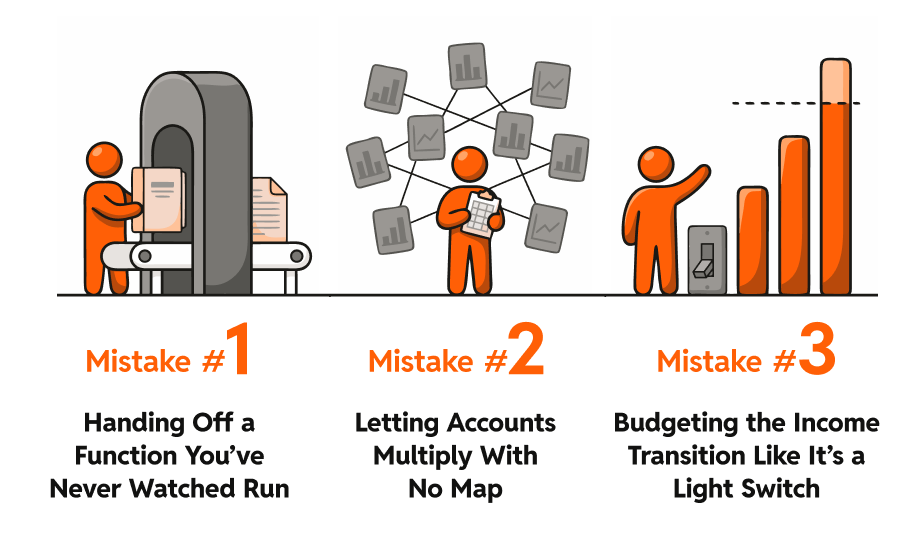
Mistake 1: Handing Off a Function You’ve Never Watched Run
Why it looks right: Because it is right, eventually. A CEO would never do the work of the bookkeeper. I believe that. I’ve said it for years. When your wealth becomes a real business, the rinse-and-repeat work belongs with someone whose job it is.
What it actually costs: If you’ve never watched a function run end to end, you can’t tell good work from bad work. You can’t read the report and know what’s missing. You can’t ask the right question when a number looks off, because you don’t know what the number is supposed to look like. So you’re not delegating. You’re hoping.
I learned this in the right order, almost by accident. After 2016, when we got serious about running this like a business, my wife and I were working so hard to operate the thing ourselves that it became genuinely frustrating. By 2017 and 2018 it was crystal clear we needed to take the repeatable work off our plate — so we hired a bookkeeper.
But by then we knew exactly what the job was. We’d lived it. We could hand it off and hold it accountable.
What the alternative looks like: Understand, then delegate. Go through one full cycle of a function yourself — one month-end close, one quarterly report, one tax-prep handoff — so you know what good looks like. Then hand it off. You’re not doing the job forever. You’re earning the right to lead it.
That’s exactly what our member is doing. He’s not against delegating. He’s against delegating blind.
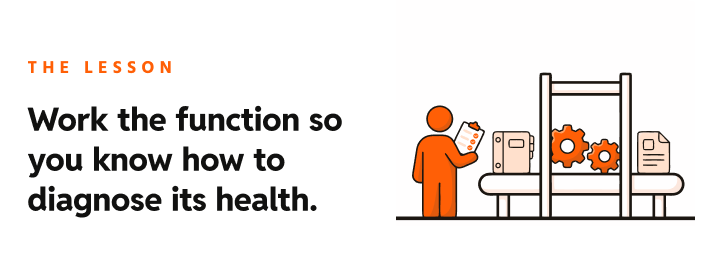
The lesson: work the function so you know how to diagnose its health. Before you hand anything off, know three things. What’s the definition of done — what result do you actually want? What can go wrong? And which reports tell you it’s working? You don’t need to be the bookkeeper. You need to understand enough about your business to ask the right questions and verify, from the reports, that things are functioning correctly.
Mistake 2: Letting Accounts Multiply With No Map
Why it looks right: Every account arrives attached to a good decision. A new brokerage account for a new sleeve. A private equity fund — which brings another K-1 to chase every tax season. Another entity, with its own set of books. And it’s never been easier to open an account in five minutes — so the old 401(k) from two jobs ago stays where it is, and the IRAs keep multiplying. Each one makes sense on its own.
What it actually costs: Nobody notices the pile until the first real close. When our member started closing his own books, he found himself working across dozens of accounts, with a separate set of books for each of his entities. His read was honest: it’s not really hard, it’s just really time-consuming — and you have to be careful. One month-end turned into a slog that took over his household for days.
That’s the hidden cost. Not a dollar figure. Hours — every single month — spent reconciling complexity you never decided to build.
What the alternative looks like: Less is more. When you’re running a family office, every account you don’t need is a cost you pay every month.
Start with a map — one place that lists every account, every entity, every K-1 you expect, and what each one is for. Then a spring cleaning: roll the stray 401(k)s, consolidate the IRAs, close the brokerage accounts that exist only because nobody closed them. Our member is doing exactly that now. The close gets simpler every time the map gets shorter.

The lesson: only add accounts that add value to your business — and simplify every year. An account is not a tracking tool. If you want to see a goal, a sleeve, or a bucket of money on its own, do that in your tools and reports, not by opening another account. Every account you add is one more thing to reconcile, report on, and eventually close. Make simplifying part of every annual review.
Mistake 3: Budgeting the Income Transition Like It’s a Light Switch
Why it looks right: You’ve made the allocation decision. You’ve shifted part of the portfolio toward income. The yields are right there on the fact sheet. So you budget as if the income shows up next month.
What it actually costs: It doesn’t show up next month. What our member learned — and shared with the group without any drama — is that moving a portfolio over to income-generating assets takes one to two quarters before the income is really up and running. In the meantime, cash flow runs negative against the budget.
The real danger isn’t the shortfall itself. It’s what people do about it. The shortfall tempts you to sell assets to cover the gap — which breaks one of the core principles of how the ultra-wealthy operate: Generate Income from Assets, Not Asset Sales.
What the alternative looks like: Budget the ramp, not the destination. Plan for one to two quarters of transition, and hold a bridge for the gap, so the shortfall never forces a sale. Our member put it simply: not a smoking hole, not a three-point landing either. That’s what an honest year-one scorecard looks like.

The lesson: build a cushion on both sides of the income. First, build a cash and capital preservation layer whose job is to absorb shortfalls — so a slow quarter gets covered by the layer, not by selling assets. Second, build your income to 125% to 150% of what you actually need, because some sources will always come in late or light. And know the timing of the ramp — how long each new income source takes to reach full speed — before you count on it.
Key Takeaways
You can’t delegate what you don’t understand. Work the function once so you know the definition of done, what can go wrong, and which reports show it’s healthy. Then hand it off — and lead it.
Every account arrives attached to a good decision — and the pile still costs you. Less is more. Map every account, entity, and K-1, then roll, consolidate, and close what you don’t need.
Income ramps, it doesn’t switch on. Build a cash and capital preservation layer to absorb shortfalls, target income at 125–150% of need, and know how long each source takes to ramp.
Your Move This Weekend
One audit. Ninety minutes. It surfaces all three mistakes at once.
Step one — list every recurring function in your operation. Month-end close. Bill pay. Reporting. Collecting K-1s. Tax prep handoff. Entity filings. Insurance renewals. Whatever runs on a schedule.
Step two — next to each one, write two things: who does it today, and Y or N: could you explain how it works in two minutes?
Any function that’s delegated and has an N next to it — that’s your Mistake 1. Pick one, and sit through the next full cycle of it this quarter. Watch it run. Then decide whether it’s in the right hands.
Step three — count your accounts. Every bank account, brokerage account, old 401(k), IRA, and entity — plus every K-1 you’ll be waiting on next spring. Write down one number. Circle anything you can’t immediately explain the purpose of. That’s your Mistake 2 list.
If you’re mid-transition to income, add one line: the quarter you expect the income sleeve to actually cover your spending. If you can’t name it, you haven’t budgeted the ramp yet — that’s Mistake 3.
Completion signal: a Y or N next to every function, and one account count at the bottom of the page. That’s it. You’ll know more about your own operation on Sunday night than most CEOs learn in a year.
Held beats pretty.
A beautifully delegated operation you don’t understand isn’t leverage. It’s a blind spot with a monthly invoice. Understand it once. Then hand it off — and lead it.
Move your portfolio and your family office forward. Have more time to yourself.
Let’s keep building.
—Christopher
P.S. The operating side of a Family Office — the books, the entities, the cadence, knowing what to delegate and when — is a big part of what members build inside the Micro Family Office Accelerator. If your audit comes back with more N’s than Y’s, you’re in good company. That’s exactly where most of our members start. The WealthOps Way is the place to begin.
👉 Start here: The WealthOps Way
Go Deeper
🎯 Start here if you’re new — The WealthOps Way Free, 2-hour live workshop. Where the operating discipline starts.
The structured build path: Micro Family Office Accelerator — Year 1 of the WealthOps membership.
Recent arc:
How Much I’m Telling My Kids About Our Money — the 5-level ladder for reading your family in (confirm slug after publish)
Why I Start My Q4 in September — the four-area annual review
By 2030 AI Runs Your Wealth. Here’s the Trap. — AI as your operations manager, not your decision maker
Today: three year-one operating mistakes — and the audit that catches them
Next Friday: one year of building the membership. What 233 members across 38 states and 18 countries have actually built — and a check-in on the predictions I put on the record this year.
New here?
I’m Christopher. I built my Family Office after my 2012 IPO — after googling “how to build a family office” and hitting the $100M wall the industry has quietly agreed on. Moved to Madrid with my family this summer. Now lead a community of more than 230 practitioners at WealthOps, and we’re building Eterna, the AI platform behind our approach. If this is your first issue — welcome. The best place to start is The WealthOps Way (wealthops.io/go). Free workshop, full rulebook, no pitch.
This is education, not advice. Learn the systems, don’t copy blindly.

Join me for The WealthOps Way—our free live workshop designed to help you stop guessing and start running your wealth like a business.
You’ll go from scattered to strategic as you craft your own Portfolio Thesis—the foundation of everything that follows.
Spots are limited—and the clarity you’ll gain? Game-changing.
Let’s build your portfolio like it’s your next great company!

If you like the newsletter, support us by letting us know what you think (one click); please do that now!
PS...If you're enjoying Managing Tech Millions, please consider referring this edition to a friend.
If this was useful, tap the ❤️ button. It tells Substack to show more writing like this.

And whenever you are ready, there three ways I can help you:
Follow me on LinkedIn: Get more insights and real-time updates.
Watch on YouTube: Dive deeper into wealth strategies and interviews.
Get in Touch: Ready for a bigger move? Let’s talk.

Disclaimer: This newsletter is for informational purposes only and does not constitute financial or career advice. Always consult with qualified professionals before making any decisions based on the information provided.